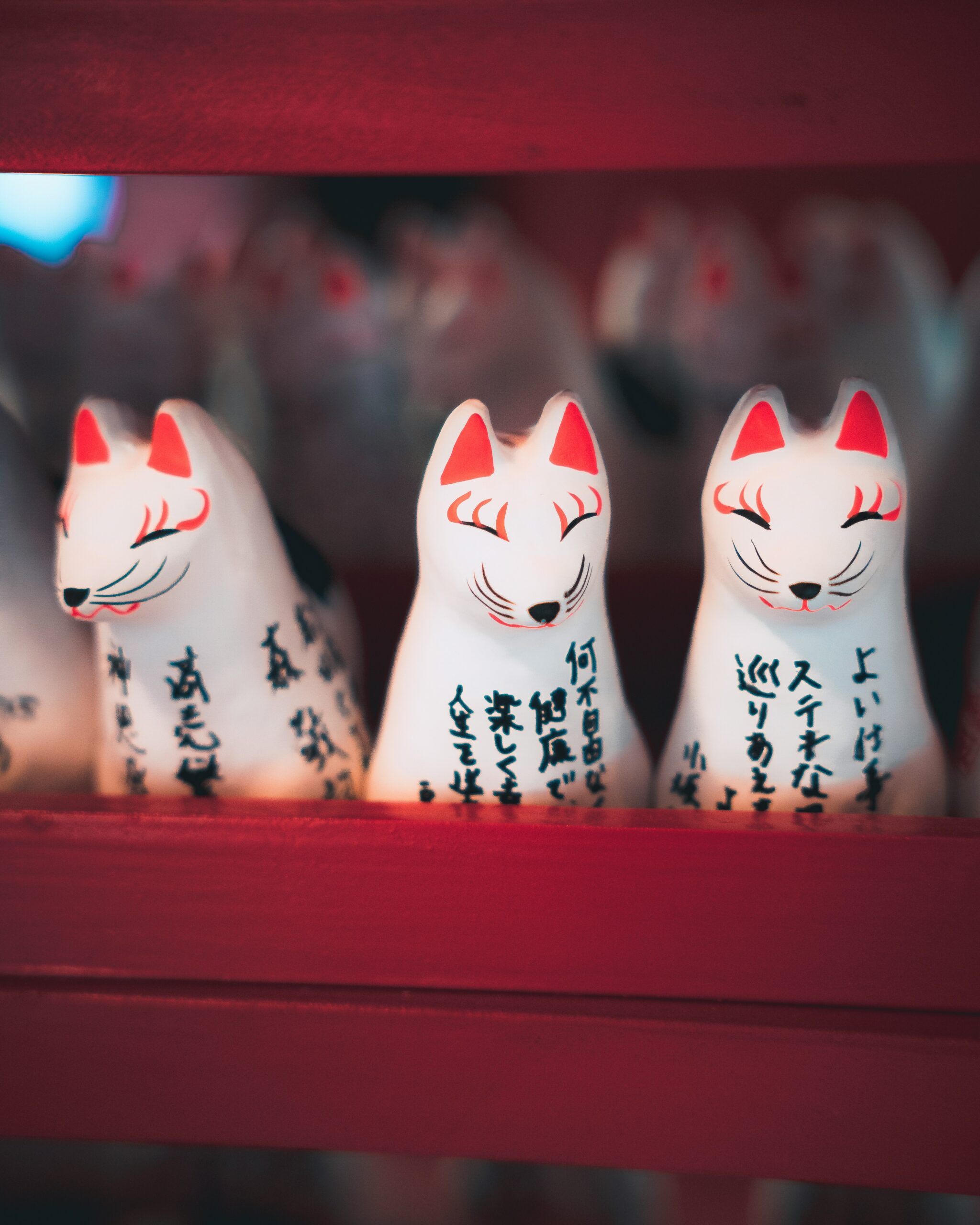
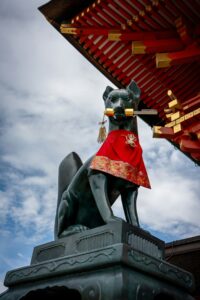
Walk through almost any Inari shrine in Japan — and there are roughly 30,000 of them — and you will find foxes. Stone foxes flanking the entrance gate. Fox statues wearing small red bibs. Fox imagery on ema votive plaques, on omamori charms, on the wooden tablets where worshippers write their prayers. The fox is everywhere in Japan’s sacred landscape, and its presence connects to one of the country’s oldest and most layered supernatural traditions: the kitsune.
Origins: Fox Spirits Across East Asian Tradition
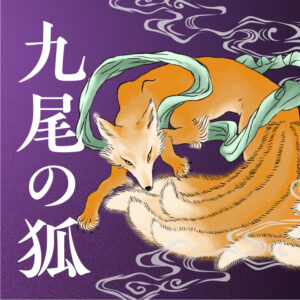
The concept of supernatural fox spirits predates Japan’s indigenous traditions, entering Japanese culture through contact with Chinese and Korean folklore where fox spirits were already well established. In Chinese tradition, the huli jing (fox spirit) was primarily associated with deception and dangerous seduction. Korea’s gumiho shared similar trickster associations.
Japan absorbed these traditions but developed the kitsune in distinctly Japanese directions — adding layers of spiritual significance, regional variation, and an ambiguity that sets the kitsune apart from its continental cousins. Japanese fox spirits can be benevolent or malevolent, sacred or dangerous, divine messengers or cunning deceivers — and sometimes all of these simultaneously.
The Kitsune’s Nature: Trickster, Messenger, and Divine Fox
Japanese tradition divides fox spirits broadly into two categories: zenko (good foxes) and yako or nogitsune (wild or mischievous foxes). This distinction is crucial to understanding why the kitsune appears both in sacred shrines and in ghost stories.
Inari no kitsune: the divine messenger
In Shinto tradition, foxes serve as the messengers (tsukai) of Inari Ōkami, the deity of rice, agriculture, fertility, industry, and worldly success. This association is ancient — references to Inari’s fox messengers appear in records from the Nara period (8th century CE). Inari shrines, identifiable by their distinctive vermillion torii gates and fox statues, are the most common shrine type in Japan, making the divine kitsune genuinely ubiquitous in Japanese religious life.
The trickster fox
Parallel to the sacred tradition, folk literature is full of kitsune who deceive, seduce, and confuse humans. The shape-shifting fox — typically appearing as a beautiful woman — appears in countless tales from the Heian period onward. A recurring theme involves a man who marries a woman, only to discover she is a kitsune when she is spotted by a dog (foxes, in folklore, fear dogs) or when her tail becomes visible. The marriage is dissolved, but the fox wife often leaves behind children — a motif used to explain certain families’ unusual talents or characteristics.
Tails, Intelligence, and Age
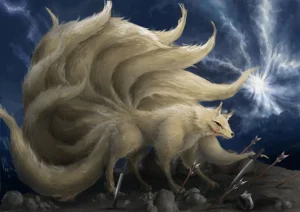
A kitsune’s power and wisdom are signified by the number of tails it possesses. Young foxes have a single tail; as centuries pass and wisdom accumulates, additional tails grow, up to a maximum of nine. A nine-tailed fox (kyūbi no kitsune) represents the highest level of foxly power and wisdom — some traditions hold that upon reaching nine tails, a kitsune’s fur turns white or gold and it ascends to a divine state.
This progression gives the kitsune a particular quality rare in supernatural beings: the capacity for genuine growth and transformation. The young fox is mischievous and unpredictable; the ancient nine-tailed fox is wise, powerful, and often benevolent. Age, in the kitsune tradition, brings not decay but elevation.
Kitsune in Japanese Art and Literature
The fox spirit permeates Japan’s artistic heritage across every medium and period.
Classical literature
Stories of fox women appear throughout the Konjaku Monogatarishū (12th century), Japan’s great collection of Buddhist and secular tales. The Genji Monogatari (The Tale of Genji, 11th century) references fox possession as an explanation for mysterious illnesses. The noh theatre tradition includes several plays centred on fox spirits, with the most famous being Kokaji, in which the fox deity assists in the forging of a legendary sword.
Woodblock prints and visual art
The Edo period’s woodblock print tradition produced innumerable fox images — particularly popular were depictions of fox weddings (kitsune no yomeiri), said to take place when sun and rain fall simultaneously, producing what English-speakers call a “sun shower.” Hiroshige and Utagawa Kuniyoshi both produced celebrated fox-themed works.
Experiencing Kitsune Culture in Japan

The most immediate way to encounter kitsune culture is through Japan’s Inari shrines.
Fushimi Inari-taisha, Kyoto
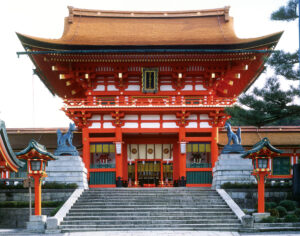
The head shrine of all Inari worship in Japan, Fushimi Inari is famous for its seemingly endless tunnel of torii gates climbing the mountain behind the main shrine buildings. Thousands of fox statues of varying ages and conditions line the paths — a visually extraordinary experience at any time of year, but particularly atmospheric at dusk or in early morning before the crowds arrive.
Toyokawa Inari, Aichi Prefecture
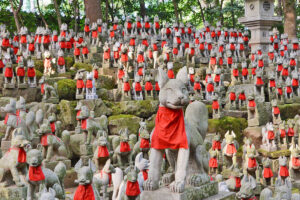
Technically a Zen Buddhist temple rather than a Shinto shrine (a legacy of the complex historical mingling of Buddhism and Shinto), Toyokawa Inari is famous for its fox statue garden, where thousands of stone foxes of every size crowd together in an otherworldly assembly.
The kitsune endures because it captures something genuinely complex about the natural world and the human experience of it — the fox who is both wild and civilised, both helpful and dangerous, both animal and spirit. In a culture that has always found meaning at the boundary between the human and non-human worlds, the fox spirit remains perfectly, permanently at home.