Matcha: The Green That Shaped Japanese Culture
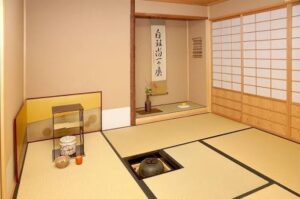
In Kyoto, there is a doorway barely two feet wide. To enter, you must crawl. You leave your sword outside, your title, your pride — everything that tells the world who you are in the hierarchies that govern life beyond that garden path. Inside: two tatami mats, a ceramic bowl, and silence deep enough to hear your own breathing. This is the room Sen no Rikyū built in the sixteenth century, and almost nothing about it makes sense until you understand that the tea was never really about tea.
To trace the history of matcha is to trace the spine of Japanese civilization itself — its Zen monasteries, its philosophy of beautiful poverty, its insistence that the most sacred things in life cannot be reproduced or purchased or scaled. What the world has recently flattened into a latte flavor and a wellness supplement is, in truth, one of the most sophisticated cultural systems ever built around a bowl of whisked green powder.
A Drink That Was Never Just a Drink
From a Chinese Monk’s Bag to a Zen Monastery’s Bowl
Matcha arrived in Japan not as a luxury but as medicine and method. In the late twelfth century, the Buddhist monk Eisai (Myoan Eisai) returned from his studies in China carrying something in his bag that would, over the following centuries, quietly reorganize Japanese culture: powdered green tea and the seeds of the tea plant itself. He brought with him a Chinese text on the health properties of tea, a book he later expanded into what became Japan’s first treatise on the subject. But Eisai’s interest was never purely dietary. Tea, for him, was inseparable from the practice of Zen — the school of Buddhism he had come home to transmit.
He planted the first seeds on the grounds of Kyoto temples, and it was within those temple walls that matcha took its first deep root in Japanese soil. The drink spread slowly, monk to monk, monastery to monastery, along the pathways of Zen practice rather than along trade routes or courtly fashion. This origin matters enormously. It means that from its very beginning in Japan, matcha was not a commodity but a contemplative tool.
Why Buddhist Monks Reached for Matcha Before Meditation
The practical reason is elegant in its simplicity: matcha keeps you awake without agitating the mind. The combination of L-theanine — an amino acid that promotes calm alertness — and natural caffeine produces a state that Zen practitioners found almost tailor-made for long hours of seated meditation. Unlike the jittery edge that other stimulants produce, matcha seems to sharpen attention while softening anxiety, a quality that monks described in experiential rather than chemical terms: the mind becomes clear like still water.
But the monks were not merely self-medicating. The act of preparing and drinking tea became, in the monastery context, a form of practice in itself — a way of bringing the same quality of full attention to the movement of a ladle or the temperature of water that one brings to formal sitting meditation. This is the root from which everything else in Japanese tea culture grows. The bowl is not a vessel for a beverage. It is an object of contemplation.
The Radical Who Remade an Entire Aesthetic
Sen no Rikyū and the Philosophy of Deliberate Poverty
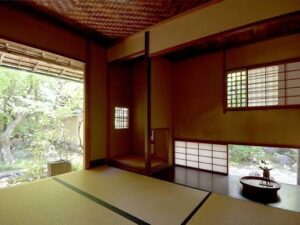
By the sixteenth century, tea had moved from monasteries into the hands of warlords, and it had become, in the process, dangerously gorgeous. Powerful men competed to display the most valuable Chinese ceramics, the most opulent tearoom furnishings. Tea gatherings were theatrical displays of wealth dressed up as spiritual refinement. Into this world stepped Sen no Rikyū, the tea master who served under the most powerful men in Japan — including the ruler Toyotomi Hideyoshi — and who proceeded, with extraordinary nerve, to dismantle everything they found beautiful.
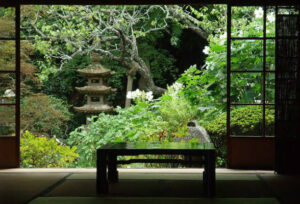
Rikyū’s aesthetic was built on a concept he developed and deepened over a lifetime: wabi, a word that resists clean translation but gestures toward the beauty found in simplicity, irregularity, and the passage of time. He replaced gleaming Chinese imports with rough Korean rice bowls. He replaced elaborate garden architecture with a single stepping stone placed at a slight angle. He built tearooms so small that a sword could not be drawn inside them. Each choice was a philosophical statement: that beauty is not found in perfection or abundance, but in restraint, impermanence, and the unpolished surface of things as they actually are.
The Crawl-Through Door That Abolished the Samurai Hierarchy
The most radical of all his gestures was structural. Rikyū designed the nijiriguchi — the crawl-through entrance, just over two feet square — for his tearoom at Taian, built around 1582 and still standing today in Oyamazaki, near Kyoto. The physics of the door make hierarchy physically impossible. A samurai carrying a sword cannot enter. A lord and a farmer must both bend their knees. Rank dissolves at the threshold.
This was not a decorative choice. In a culture organized with extraordinary rigidity around class and status, designing a door that forced every human body into the same posture of humility was a social statement as bold as any political manifesto. Inside Rikyū’s room, two people met as something closer to equals than their world normally permitted. The tea made this possible. The architecture enforced it.
What the Tea Ceremony Is Actually Saying
Wa, Kei, Sei, Jaku — Four Words That Explain Japanese Culture
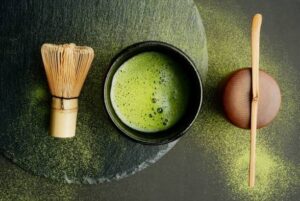 The formal tea ceremony, known in Japanese as chado (the Way of Tea), is organized around four principles that Rikyū articulated and that have echoed through Japanese culture ever since. They are wa (harmony), kei (respect), sei (purity), and jaku (tranquility). Each one sounds, in English translation, almost too simple — the kind of words that appear on decorative calendars without meaning much. Inside the tearoom, they are specific, demanding, and surprisingly difficult to enact.
Harmony means attending to every element of the environment — the season, the light, the sound of water heating — and allowing them to cohere rather than compete. Respect means treating every object and every person in the room as worthy of full attention. Purity refers not to cleanliness in any superficial sense but to a quality of undivided presence — the mind not half-elsewhere. Tranquility is what remains when the other three are genuinely practiced: a stillness that is not passive but alert. These four principles do not describe the tea ceremony alone. They describe what Japan, at its most philosophically serious, has aspired to across architecture, garden design, poetry, cuisine, and craft for five centuries.
Ichi-go Ichi-e: The Unrepeatable Moment Designed Into Every Gesture
Perhaps the most beautiful concept the tea ceremony has given Japanese culture is ichi-go ichi-e — a phrase that translates roughly as “one time, one meeting,” and means that this gathering, this bowl, this particular quality of afternoon light through this particular paper screen, will never exist again. Every movement in the ceremony is therefore performed with the awareness that it is both the first and last time it will happen in exactly this way.
This is not melancholy. It is, if anything, the opposite — a discipline of full arrival. The ceremony is designed, at the level of its gestures and its architecture and its carefully chosen seasonal objects, to make you conscious of what it feels like to be entirely present. In a world now organized around the reproducible, the scalable, and the permanently available, ichi-go ichi-e stands as one of the most quietly radical ideas in human culture.
The Craft Behind the Cup — What Most Visitors Never See
Why Shade, Silence, and a Single Piece of Bamboo Matter
The matcha in the bowl begins its life in a very specific kind of darkness. Three to four weeks before harvest, the tea farmers of Uji — the region south of Kyoto that has produced Japan’s finest ceremonial-grade matcha for centuries — cover their plants with shade cloth or bamboo frames, blocking up to ninety percent of direct sunlight. The plant, deprived of light, responds by producing dramatically elevated levels of chlorophyll and L-theanine. It turns a deeper, more luminous green. The flavor shifts from sharp and grassy to something smoother, more complex, almost sweet. This single agricultural decision — patience and deliberate deprivation — determines everything that arrives in the bowl.
After harvest, the leaves are steamed to stop oxidation, dried, and then stone-ground at a speed so slow that the friction of faster grinding would damage the delicate compounds the farmers worked so carefully to cultivate. Traditional stone mills grind at a pace that produces only thirty to forty grams of powder per hour. The resulting matcha is a different substance, in both physical and philosophical terms, from the industrially processed powder that fills most of the world’s matcha products.
The Dying Artisans of Takayama and the Whisk with 120 Tines
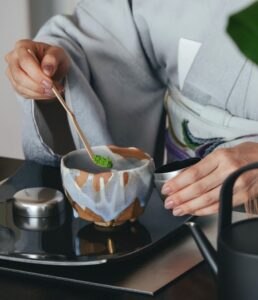
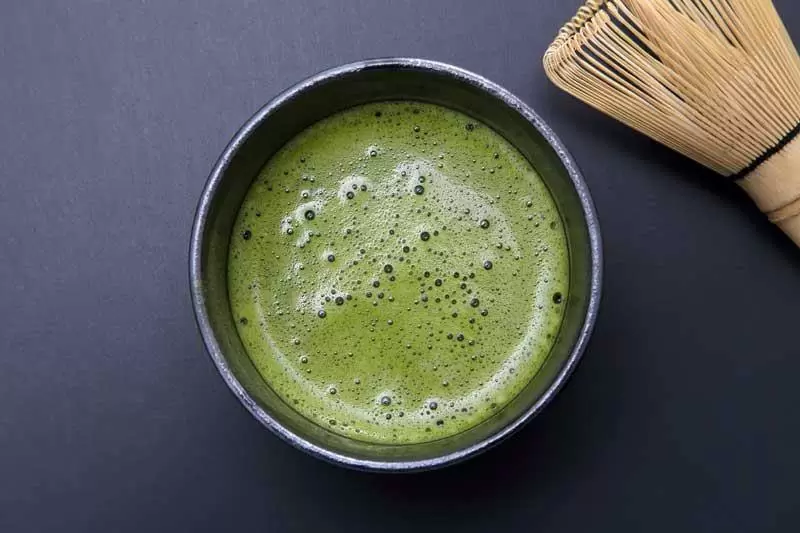
The chasen (tea whisk) is made from a single piece of bamboo — typically a variety called Madake — split by hand into anywhere from eighty to one hundred and twenty tines, each one curved and tensioned with extraordinary precision. The craft is centered in Takayama, a small district of Nara Prefecture, where it has been practiced by a single family lineage for over five hundred years. At the peak of the craft’s transmission, dozens of artisan families worked in the area. Today, fewer than ten remain.
A master chasen maker can produce perhaps three whisks in a day. Each one is unrepeatable — the specific character of that particular piece of bamboo, the slight variations in how the tines curve, the unique resonance it will have against the inside of a ceramic bowl. The whisk is not designed for longevity; it is meant to be used, slowly worn, and eventually retired. Some tea practitioners float their old whisks in water at the end of their useful life, in a small ceremony of gratitude. The object is honored for its service and released.
What the World Got Wrong — and What Japan Is Reclaiming
The Misconceptions That Flatten 800 Years Into a Latte Flavor
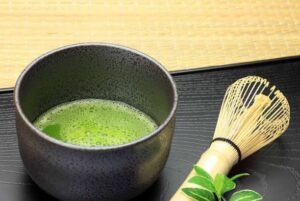
When matcha arrived in Western consciousness — somewhere around the mid-2010s, accelerating rapidly through social media — it was processed almost entirely through the language of wellness and novelty. It became an antioxidant. A superfood. A photogenic green powder that could be stirred into anything. This is not wrong, exactly. Matcha does contain what nutritionists describe as beneficial compounds. But the reduction is staggering in its thoroughness. Eight hundred years of philosophical development, of aesthetic refinement, of a culture’s sustained meditation on presence and impermanence — compressed into a menu item.
The irony is that the very qualities the wellness world celebrates in matcha — its calming alertness, its invitation to slow down — are products of the exact philosophical tradition that the commodification erases. You cannot fully receive what matcha offers while consuming it in forty-five seconds on your way to a meeting. The tradition understood this. The tradition built a two-foot doorway to make sure you understood it too.
Young Japan, Ancient Practice — Zen Renewed or Diluted?
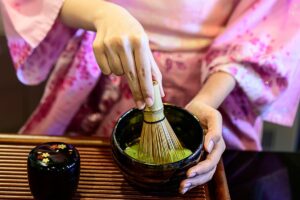
Inside Japan, something interesting is happening. A generation of younger Japanese people who grew up largely indifferent to the tea ceremony — too formal, too slow, too much the domain of elderly women in kimono — is finding its way back. Not always through traditional schools, with their strict hierarchies of practice and years of apprenticeship, but through something more personal and exploratory: small independent tea studios, younger teachers who bring chado into conversation with contemporary aesthetics, practitioners who see in the ceremony’s principles of attention and presence exactly what their screen-saturated world most needs.
Whether this renewal deepens the tradition or dilutes it is a question Japanese culture is working through in real time. Both things are probably true simultaneously, and the tension between them is itself very Japanese — the same tension that produced Rikyū, who honored the old masters deeply enough to overturn everything they thought they knew about beauty.
Rikyū’s tearoom at Taian opens to visitors only a handful of days each year. It seats, effectively, two people. There is no way to experience it at scale, no way to photograph it adequately, no way to carry it home. It can only be entered on your knees, in silence, one time that will never come again. This, more than any ingredient or preparation method, is what matcha has always been trying to teach: that the most profound things are not scaled up, not packaged, not explained in a menu. They are entered slowly, with full attention, and released just as fully when the moment has passed.
To understand matcha is to begin understanding wabi-sabi — explore how Japan turned imperfection into its highest aesthetic ideal.