Table of Contents
- What Is Fushimi Inari Taisha — and Why It Matters
- Walking the Trail — A Landmark-by-Landmark Guide
- When to Go — Seasons, Crowds, and the Golden Hours
- Getting There, Costs, and What to Bring
- Common Mistakes, Myths, and Local Secrets
The first gate appears like a flame in the mist. Then another. Then another, until the path ahead becomes a corridor of burning orange-red arching overhead in an unbroken tunnel that seems to have no end. At dawn, when the mountain is nearly silent and threads of fog drift between the wooden pillars, walking through the torii gates of Fushimi Inari feels less like sightseeing and more like crossing into another world entirely. But here is what the famous photographs don’t tell you: the gates stretch for nearly four kilometers up a forested mountain, and the overwhelming majority of visitors turn back within the first fifteen minutes. What lies beyond — quieter, wilder, and infinitely more rewarding — is the experience this guide exists to help you find.
What Is Fushimi Inari Taisha — and Why It Matters
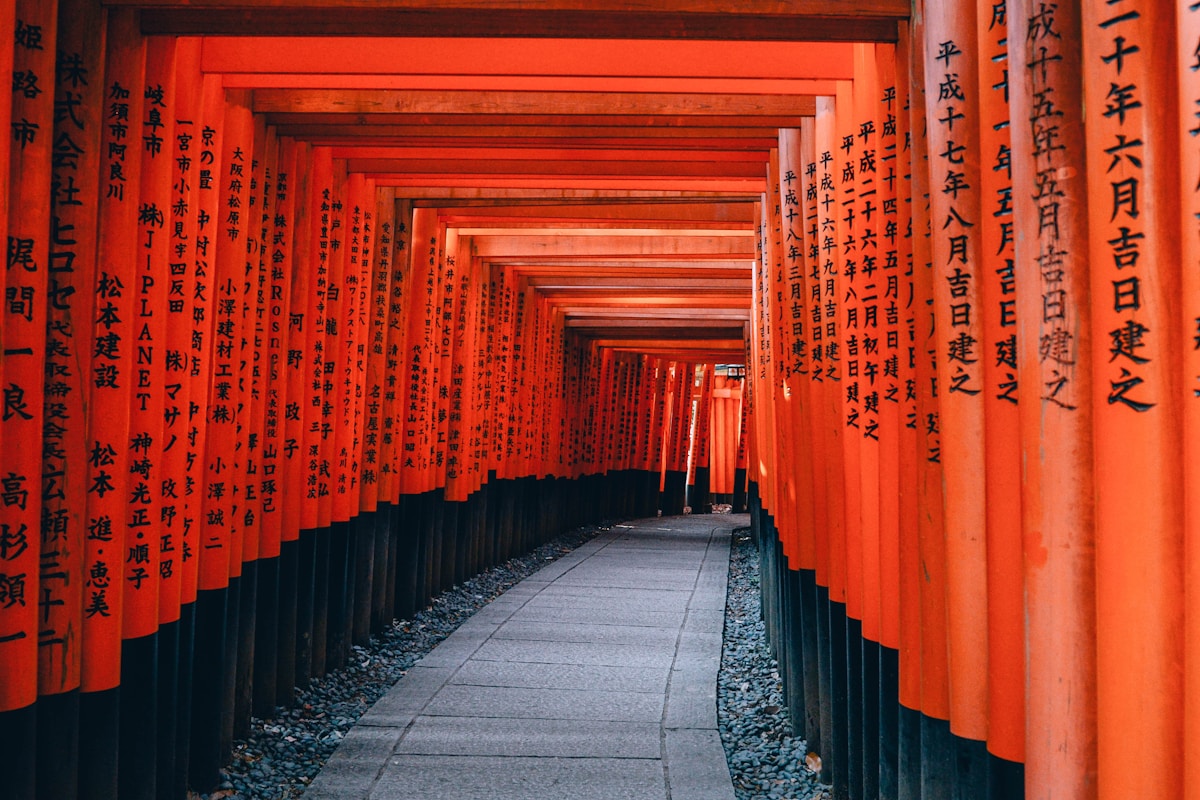
A Shrine Older Than Kyoto Itself (Founded 711 CE)
Most visitors assume Fushimi Inari is simply a landmark attached to the city of Kyoto. In fact, the shrine predates Kyoto’s establishment as Japan’s imperial capital by nearly a century. Fushimi Inari Taisha was officially founded in 711 CE, making it one of the oldest and most historically significant religious sites in the entire country. When the imperial court relocated to Kyoto in 794, the shrine’s importance only grew — it was formally incorporated into the city’s spiritual geography and has remained at the center of Japanese religious and cultural life ever since.
The main shrine buildings sit at the base of Mount Inari, a sacred peak rising 233 meters above the surrounding plains of southern Kyoto. The mountain itself is considered a living deity, and the thousands of gates that line its trails are not merely decorative — they mark a continuous pilgrimage path that devotees have walked for over a thousand years. To climb the mountain is, in the traditional sense, an act of worship.
Inari, Foxes, and the Meaning Behind the Gates
The shrine is dedicated to Inari, the Shinto deity of rice, agriculture, industry, and worldly success. In an agrarian society, these were the forces that determined whether a family would survive the winter, and Inari’s favor was eagerly sought by farmers, merchants, and craftspeople alike. Today, the deity is still widely venerated by business owners across Japan, and you’ll find small Inari shrines tucked into corners of restaurants, factories, and office buildings throughout the country.
The kitsune, or fox, serves as Inari’s messenger and guardian — which explains why stone fox statues flank virtually every gate and altar on the mountain. These foxes are typically depicted holding symbolic objects: a key, a jewel, a sheaf of rice, or a scroll. They are not worshipped themselves but respected as intermediaries between the human world and the divine. As for the gates: each of the roughly 10,000 vermilion torii structures on the mountain was donated by an individual, family, or company in gratitude for prayers answered. Inscriptions on the back of each gate record the donor’s name and the date of the gift — a tradition that continues to this day.
Walking the Trail — A Landmark-by-Landmark Guide
From the Rōmon Gate to the Famous Senbon Torii
Your journey begins at the Romon Gate, the imposing two-story entrance structure that marks the transition from the ordinary world into sacred space. Pass through it, and you’ll enter the main shrine precinct where the principal halls of worship stand — beautifully maintained, often fragrant with incense, and worth pausing at before the hike begins. Many visitors rush straight past this area toward the gates, but the main shrine itself is genuinely moving and deserves at least ten minutes of quiet attention.
From the main hall, a broad stone path leads upward to the first of the dense gate tunnels. This is the Senbon Torii — literally “thousands of torii gates” — and it is, without question, one of the most visually extraordinary places on earth. The gates are spaced so closely together that walking through them feels like moving through a series of amber-lit chambers, the light shifting and filtering through gaps in the wood. The path soon forks into two parallel tunnels; take either one, as they rejoin shortly afterward. Morning light through these tunnels is genuinely transformative. Midday sun flattens the color; the hour after sunrise saturates everything in gold.
Beyond the Crowds: Okusha, Yotsutsuji, and the Summit
After the Senbon Torii, most visitors arrive at the Okusha worship hall — a small structure deep in the forest surrounded by hundreds of miniature torii gates, fox statues, and stone lanterns. The atmosphere here is hushed and genuinely sacred. This is where most tourists stop, take their photographs, and turn back. It is also, conveniently, where the real hike begins.
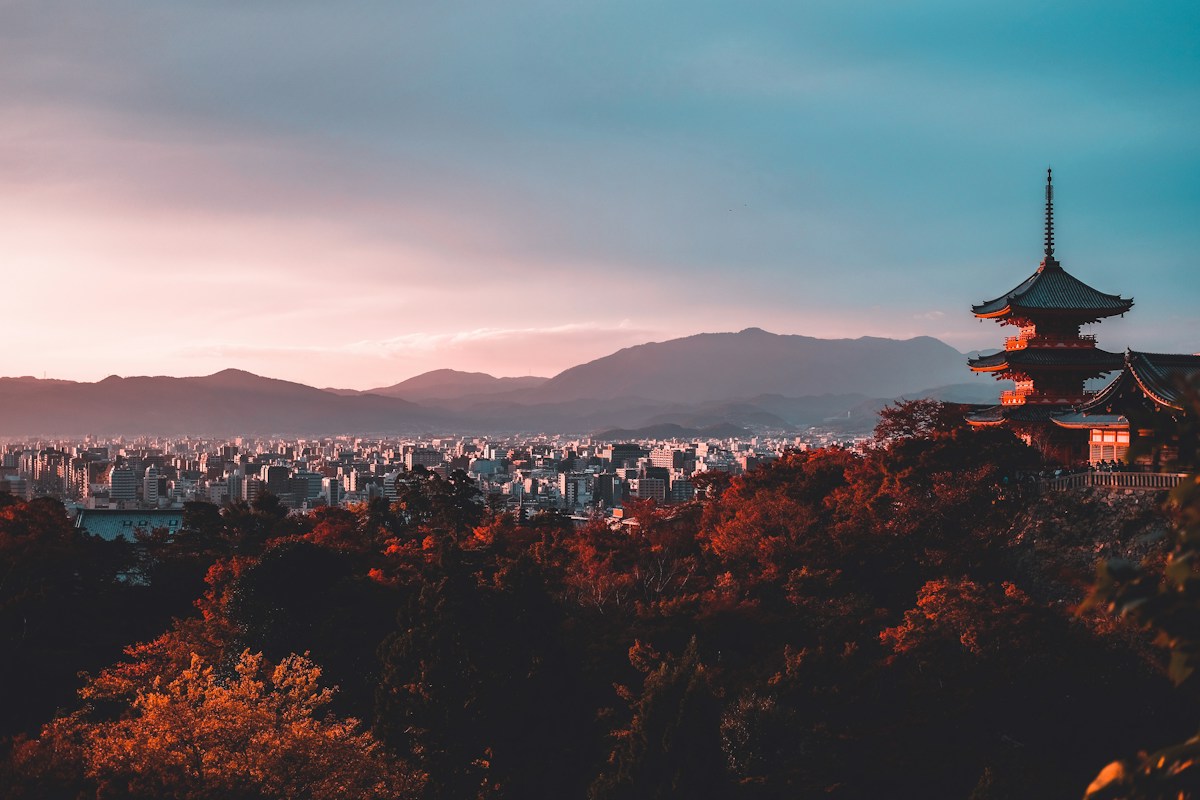
Continuing upward, you’ll reach Yotsutsuji, a crossroads intersection roughly halfway up the mountain that offers the first panoramic view back over Kyoto. On a clear morning, the city spreads out below you like a map, with the Higashiyama mountains rolling in the distance. Rest here, drink some water, and take in what most visitors never see. From Yotsutsuji, the path continues upward through quieter gate tunnels, smaller sub-shrines, and increasingly dense forest. The summit of Mount Inari rewards those who make it with a sense of earned stillness — fewer people, softer sounds, and the peculiar peace of a mountain that has been prayed upon for thirteen centuries.
When to Go — Seasons, Crowds, and the Golden Hours
The One Time Slot That Changes Everything (Early Morning)
Fushimi Inari is open 24 hours a day, 365 days a year — and this single fact is the most important piece of planning information you can have. The shrine receives well over three million visitors annually, with the overwhelming majority arriving between 10 AM and 3 PM. Arrive at 6 AM, or better yet 5:30 AM, and you will find a completely different place. The gates glow in the low light. The foxes stare from the shadows. Your footsteps echo. You may walk for twenty minutes without seeing another person. This is Fushimi Inari as it was meant to be experienced, and it requires nothing more heroic than setting an early alarm.
Evening visits — arriving around sunset and staying into the early night — offer a second window of magic. The gates are lit at certain points, the crowds thin after 7 PM, and the forest takes on an altogether more mysterious quality after dark. It is entirely safe and deeply atmospheric.
Seasonal Highlights From Cherry Blossoms to Winter Snow
Every season brings something distinct to the mountain:
- Spring (late March to mid-April): Cherry blossoms bloom near the entrance and lower trails, layering pink softness against the hard geometry of the vermilion gates. Crowds peak during this period, making the early morning rule especially critical.
- Summer (June to August): Lush green canopy transforms the upper mountain into a cathedral of shade. Humid, yes — but the forest is extraordinarily alive, and summer rainstorms on the mountain are their own kind of drama.
- Autumn (mid-November to early December): Maple leaves turn copper and crimson, complementing the gates in colors that feel almost absurdly perfect. One of the most beautiful times to visit.
- Winter (December to February): Snow on the torii gates is rare but unforgettable. Crowds drop significantly, the air is crystalline, and the mountain feels profoundly still.
Getting There, Costs, and What to Bring
Access by Train and Why JR Is Your Best Option
Fushimi Inari is located in the Fushimi district of southern Kyoto, roughly 30 minutes from central Kyoto Station by local train. The most convenient option is the JR Nara Line, which deposits you at Inari Station — literally a two-minute walk from the shrine’s main entrance. If you carry a Japan Rail Pass, this journey costs nothing extra. Trains run frequently throughout the day, with early morning services beginning before 5 AM, which makes the dawn visit entirely practical even without a car.
Alternatively, the Keihan Electric Railway stops at Fushimi-Inari Station, a slightly longer five-minute walk to the entrance. Both options are reliable; the JR route simply delivers you closer to the gate.
Admission, Trail Conditions, and Packing Smart
Admission to Fushimi Inari is completely free — always has been, likely always will be. There are no tickets, no timed entry slots, and no booking required. The trail to the summit is well-maintained stone steps and paved paths throughout, but it is a genuine mountain hike: roughly two hours at a moderate pace for the full round trip, with consistent elevation gain on the ascent.
Pack accordingly:
- Comfortable, closed-toe walking shoes with grip (not sandals)
- A refillable water bottle — vending machines exist at certain rest points on the trail
- Layers, especially for early morning visits in spring and autumn
- A small flashlight or phone torch if visiting at dawn or dusk
- Cash for food stalls near the entrance and small offerings at sub-shrines
Common Mistakes, Myths, and Local Secrets
Busting the Biggest Misconceptions About Fushimi Inari
The most common mistake is treating Fushimi Inari as a quick photo stop. Many visitors spend twenty minutes, get the Senbon Torii shot, and leave — which is a little like visiting the Grand Canyon, taking a selfie at the rim, and driving away. The mountain is the experience. Give it at least two hours; give it a full morning if you can.
Another widespread myth: that the site is somehow spoiled by tourism. Yes, the entrance area is extremely busy at peak hours. But climb past the Okusha hall and the crowds thin dramatically. By the time you reach Yotsutsuji, you’ll often find only a handful of other hikers. The summit can feel genuinely private. The mountain is larger and more resilient than Instagram suggests.
Hidden Gems — The Balancing Stones, Rice Pocket Snacks, and Stray Cats
Near the Okusha hall, look for the Omokaru-ishi — a pair of stone lantern tops that serve as a folk divination ritual. Visitors make a wish, then lift one of the stones. If it feels lighter than expected, the wish will come true. If heavier, more effort is required. It’s quietly charming, frequently overlooked, and surprisingly moving in practice.
On the way up, stop at one of the food stalls near the entrance for inari-zushi — seasoned rice stuffed into sweet, deep-fried tofu pockets. The snack is named for the shrine deity and has been sold here for generations. It’s inexpensive, portable, delicious, and deeply local.
Finally: keep an eye out for the cats. Fushimi Inari has a well-established colony of friendly strays who have made the mountain their home. They lounge on stone walls, nap beneath fox statues, and generally regard visiting humans with magnificent indifference. They are unofficial residents of the sacred mountain and, for many visitors, an entirely unexpected highlight.
Fushimi Inari rewards effort in the most literal way possible: the further you walk, the more remarkable it becomes. The famous gates are just the beginning of a trail that climbs through history, mythology, and forest silence to something genuinely rare — a place where the ancient and the living coexist without contradiction. Set your alarm for before sunrise. Lace up shoes with grip. Walk past the crowds, past the halfway point, past the place where the path gets quiet and the only sounds are wind through cedar and the distant toll of a small bell. That is where the mountain gives you what it actually has to offer. We’d love to hear how far you made it — share your experience in the comments below, or explore our other guides to Kyoto’s most extraordinary hidden corners. The city has more secrets than any single visit can hold.
