The steam rises before anything else reaches you — a dense, fragrant cloud carrying the entire promise of what is coming. You lower your face toward the bowl and the aroma arrives in layers: first the deep animal warmth of the broth, then the sharp brightness of the tare (タレ) seasoning beneath it, then something harder to name, something that lives at the intersection of fat and heat and time. You pull a cluster of noodles from the broth. They resist for a fraction of a second — springy, alive — and come free. In Japan, slurping ramen is not merely permitted but encouraged: drawing air through the noodles cools them to the right temperature and opens the flavors in the back of the mouth. The sound is proof that you are doing it correctly. The warmth reaches your chest before you have swallowed your second mouthful. You are, for the duration of this bowl, nowhere else.
Ramen (ラーメン) is the most consumed restaurant dish in Japan — approximately twenty-four thousand shops across the country, from tiny eight-seat counters where a single chef has spent thirty years perfecting one broth to national chains serving hundreds of thousands of bowls a day. But the statistics are the wrong frame. Ramen is not primarily a food industry. It is a cultural form: a medium through which Japanese culinary philosophy, regional identity, and the perfectionism of the craft tradition have found one of their most concentrated expressions. A great bowl is the record of every decision its maker has made — which bones, how long to simmer, what salt, what width of noodle, in what order to place the toppings. Every element is a choice, and the choices are visible in the bowl. Ramen rewards the kind of attention that reveals the mind behind the making.
The Anatomy of a Bowl: Four Elements, Infinite Possibilities
Broth, Tare, Noodles, and Toppings
Every bowl of ramen is built from four distinct components, each made separately and designed to interact with the others in ways that the maker has precisely calculated. Understanding these four elements is the beginning of understanding why ramen is so inexhaustibly varied — why two shops in the same neighborhood, using the same basic category of broth, can produce bowls that taste entirely different.
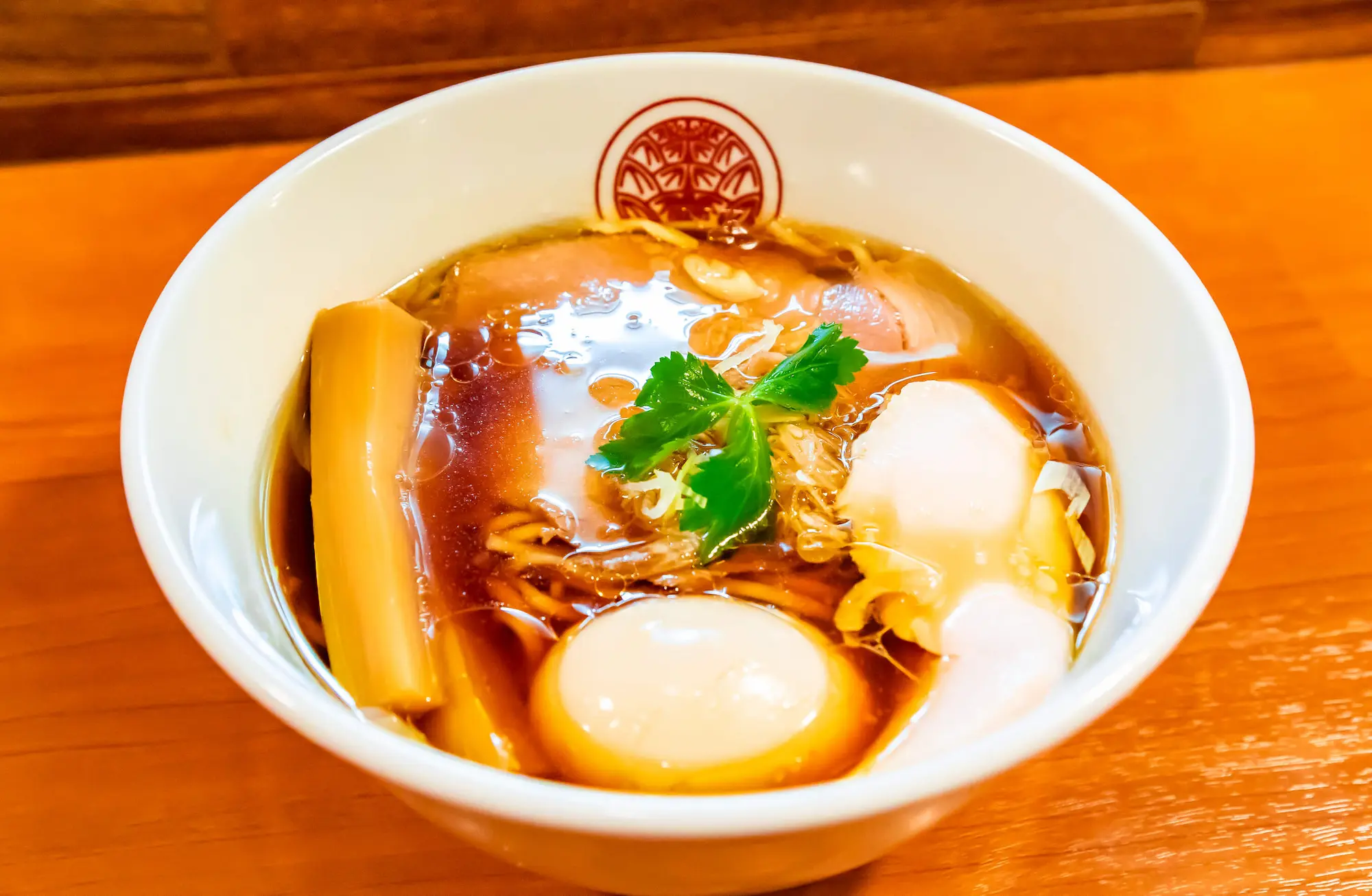
The broth (スープ, soup) is the foundation — a stock simmered from pork bones, chicken, dried fish, kelp, and aromatics over anywhere from a few hours to two days. But the broth alone is not a ramen broth. It is seasoned at the moment of service with tare (タレ) — a concentrated seasoning sauce developed separately and added to order. The combination of broth and tare is the central creative act of ramen-making; a master chef will tell you that the tare is where the real craft lives. The noodles (麺, men), made from wheat flour and kansui (かんすい) alkaline water, are calibrated to the broth — thick and wavy for heavy broths, thin and straight for lighter ones. And the toppings — chashu (チャーシュー) pork belly, marinated soft-boiled egg (ajitsuke tamago, 味付け卵), nori (海苔), bamboo shoots (menma, メンマ) — complete the bowl not as garnish but as individually prepared elements, each made to the same standard as the broth, each contributing to the final composition that the ramen master has arranged as deliberately as a painter arranges a canvas.
Shoyu: The Soul of Tokyo
Clarity, Complexity, and the Taste of the Capital
Shoyu ramen (醤油ラーメン) — seasoned with soy sauce tare — is the style most closely associated with Tokyo (東京), and it may be the one that best represents the Japanese aesthetic principle of achieving maximum complexity within apparent simplicity. The broth is clear or nearly clear, typically golden-amber in color, built from chicken and occasionally pork with a base of dried fish and aromatic vegetables. It smells of soy and smoke and something vegetal and clean. It looks, in the bowl, like it should taste mild. It does not.
The flavor of a great shoyu ramen arrives in stages. The first impression is the salt and umami of the soy tare, sharp and immediate. The second is the depth of the stock beneath it — the long-simmered sweetness of chicken bones, the mineral resonance of the dried fish. The third is something that emerges as the broth cools slightly in the mouth: a complexity that is difficult to name but easy to recognize, the flavor of many things cooked together for a long time until they become one thing that could not have existed without all of them. Tokyo’s most celebrated shoyu ramen — the style associated with the old-school shops of the shitamachi (下町) working-class neighborhoods — achieves this complexity in a broth that looks almost simple. The restraint is the point. Everything is present, and nothing is excessive.
Miso: The Bold Voice of the North
Sapporo’s Gift to the Ramen World
Miso ramen (味噌ラーメン) was invented in Sapporo (札幌) in the late 1950s — a relatively recent arrival in the history of a dish that itself only entered mainstream Japanese food culture in the postwar period. The invention is credited to a chef who began adding miso to his broth in response to the brutal Hokkaido winters, creating a style so suited to the climate and the appetite of the north that it spread across the country within a generation. Sapporo miso ramen is what happens when a cold place invents food to keep itself warm.
The bowl arrives with a visible slick of fat on the surface — lard or sesame oil or both — that holds the heat of the broth against the cold air. The broth beneath is thick and rich and opaque, made from pork and chicken stock with a miso tare of extraordinary depth: often a blend of two or three different miso varieties, fermented for different lengths of time, combined to produce a flavor that is simultaneously sweet, salty, earthy, and sharp with the particular mineral taste that fermented soybean paste acquires over months of aging. The noodles are thick and wavy, able to carry the weight of the heavy broth. The toppings are bold: a mountain of bean sprouts, corn kernels in butter, ground pork, a spoonful of chili paste. Everything about the bowl is generous, assertive, designed for maximum warmth and satisfaction. Sapporo miso ramen does not ask you to contemplate subtlety. It envelops you in it.
Tonkotsu: The Obsession of Hakata
The Broth That Takes All Day
Tonkotsu ramen (豚骨ラーメン) — from Hakata (博多), the commercial heart of Fukuoka (福岡) in northern Kyushu (九州) — is the style that most bewilders first-time visitors and most completely converts them. The broth is made by boiling pork bones — specifically the thick femur bones of pigs — at a rolling, aggressive boil for twelve to eighteen hours, emulsifying the collagen and marrow into a liquid that is opaque white, rich with fat, and so deeply concentrated that a spoonful of it coats the back of the throat. It smells intensely of pork in a way that is either immediately overwhelming or immediately compelling, depending on your preparation. For most people who try it under the right conditions, it is the latter.
The flavor is unlike any other ramen broth — everything boiled together into a unified force that hits the palate as a single dense impression: rich, savory, fatty, with the specific sweetness of long-cooked pork. The tare is typically a salty, slightly sweet soy seasoning that cuts through the fat without diminishing it. The noodles are thin, straight, and firm — hard (katamen, 硬麺) is the standard preference in Hakata, cooked only briefly so they retain their bite. A characteristic of the culture is kaedama (替え玉) — an additional serving of noodles dropped into the remaining broth after the first is finished. The broth is too good to waste.
Shio: The Purist’s Choice
Salt, Clarity, and the Chef Who Has Nothing to Hide
Shio ramen (塩ラーメン) — seasoned with salt tare rather than soy or miso — is the style that ramen chefs speak of with the particular respect reserved for the most demanding form of their craft. A salt-seasoned broth has nowhere to hide. The soy of shoyu ramen carries its own color and flavor; the miso of miso ramen fills the bowl with its own presence. Shio ramen is the broth unadorned. Its quality depends entirely on the depth and clarity of the stock itself, and on the maker’s ability to use salt — in its various mineral forms, from different sources, with different trace elements — to illuminate the flavors that the broth already contains without adding anything of its own.
The most celebrated shio ramen comes from Hakodate (函館), in southern Hokkaido — a port city whose history of Chinese and Russian influence shaped a food culture still visible today. Hakodate shio ramen is made from chicken and seafood stock, served with thin noodles in a pale, almost translucent broth. It tastes of the sea and the land simultaneously: cold-water fish providing mineral delicacy, chicken giving body. It is the ramen for people who want to taste everything — and the style that most clearly demonstrates that in Japanese cooking, restraint is not a lack of effort. It is the form that the greatest effort takes.
Regional Pride: How Japan’s Geography Became Ramen
The Country in a Bowl
Japan’s ramen geography is one of the most expressive examples of how a single food form can absorb an entire country’s regional diversity. The four broad style categories are themselves just the outermost frame. Within each, the variations follow the logic of place: local water chemistry, dominant agricultural products, culinary traditions that preceded ramen’s arrival, and the particular character of the people who make and eat it.
Kitakata (喜多方) in Fukushima Prefecture (福島県) is a small city with more ramen shops per capita than almost anywhere in Japan. Its distinctive flat, wavy noodle carries a soft, almost silky texture; the broth is a light shoyu style built on pork and niboshi (煮干し) dried sardine. People drive significant distances to eat Kitakata ramen for breakfast — a local practice known as asa-ramen (朝ラーメン) that speaks to how completely ramen has embedded itself in the daily life of the city.
Kyoto (京都) ramen is thick, dark, and intensely savory — heavy with chicken fat and a concentrated soy tare, the opposite of what you might expect from a city associated with refinement. But Kyoto’s ramen grew not from the aristocratic aesthetic of the temples but from the workers who lived around them. It is a direct expression of working-class appetite and wears that origin without apology. Wakayama (和歌山) ramen, meanwhile, blends pork bone and soy in a ratio that sounds contradictory until you taste how naturally the two traditions support each other — typically served alongside pressed sushi rice, a pairing unique to the region that reflects its deep culinary history.
The Ramen Master: A Philosophy in a Bowl
Obsession as a Form of Respect
The ramen shokunin (ラーメン職人) — the ramen craftsperson — is one of the most recognizable characters in Japanese food culture: the person who has spent decades developing a single broth; who sources bones from a specific farm because the pigs are fed a specific diet; who adjusts the tare seasoning daily in response to seasonal changes in the soy sauce; who wakes at four in the morning to start the stock. This figure is not a myth of marketing. The behavior it describes is real, visible in the bowls that the best shops produce.
The Japanese concept of shokunin kishitsu (職人気質) — the craftsperson’s spirit, the total commitment to perpetual improvement — applies to ramen with the same force it applies to the lacquerware of Kanazawa or the knife-making of Sakai (堺). The ramen shop that has been serving the same bowl for thirty years is not stagnating. It is pursuing the standard it set at the beginning, adjusting for variation in ingredients, attempting each day to produce the bowl that its maker originally imagined. The standard is always slightly ahead. That gap is what the craftsperson pursues indefinitely — and that pursuit is the practice itself.
The Experience: Why Eating Ramen in Japan Is Different
The Full Attention of a Single Bowl
There is a quality to eating ramen in Japan that is not explained by the food alone. It has to do with the physical environment — the counter seating that places the bowl directly in front of you, the proximity of the kitchen, the sounds of the chef working, the heat of the bowl warming your hands through the ceramic — and with the unspoken understanding that this is a meal for presence rather than conversation. The counter is where the full experience lives: the closest point of contact between maker and eater, the arrangement that allows the steam from the bowl to reach your face before you lift your chopsticks.
The bowl is always served immediately after it is made — finished, topped, and placed on the counter in one continuous motion. Ramen cools. Noodles soften in the broth. The window during which the bowl is exactly as its maker intended it is narrow — perhaps the first eight minutes — and eating within that window is the price of admission to the full experience. The bowl asks for your complete attention, and in returning that attention, you receive everything it has to give. The satisfaction of a finished bowl — the clean ceramic, the faint residue of tare on the bottom, the warmth that has moved from your hands to your chest — is the specific physical feeling of something made with perfect calculation, consumed with perfect attention.
Ramen is Japan in a bowl — the diversity of its regions, the depth of its craft tradition, and the particular Japanese genius for taking something from outside (ramen descends from Chinese noodle soups brought to Japan in the late nineteenth century) and transforming it through perfectionism into something that could only have come from here. To eat ramen in Japan with genuine attention is to taste every choice the maker made, every hour the broth simmered. It is a humble vessel for an extraordinary inheritance.
The same philosophy of craft and regional pride that shapes Japan’s ramen culture runs through every aspect of Japanese food — and if ramen is the soul of Japan’s street-level culinary life, then the formal counterpoint to that soulfulness is found in the exquisite seasonal artistry of washoku, Japan’s traditional cuisine and the UNESCO-recognized expression of everything the country has understood about eating beautifully.