 A kimono takes between fifteen minutes and an hour to put on, depending on the formality of the occasion and the skill of the dresser. It requires knowing, in advance, what season it is, what occasion you are attending, what your social position in relation to the other attendees is, and roughly what time of day the event will take place. It requires a minimum of three separate under-layers, a complex system of cords and collars, and the assistance of another person or considerable practice. When it is on correctly, it is not, in the ordinary sense, comfortable. And yet the people who wear kimono — who choose to wear it, when wearing it is entirely optional — describe the experience as one of remarkable physical and mental clarity: the garment disciplines the body, and in disciplining the body it disciplines the mind.
The kimono (着物) — the word means simply “thing to wear” — is the traditional garment of Japan. This unremarkable etymology disguises what the garment actually is: the most sophisticated encoding in textile form of a civilization’s accumulated understanding of aesthetics, seasons, social hierarchy, the relationship between the body and time, and the idea that what you wear is not a personal statement but a cultural communication. A kimono is not clothing in the sense of something chosen for comfort or self-expression. It is a text, and it requires literacy to read — and still more literacy to write correctly.
The Construction: What Makes a Kimono a Kimono
One Bolt, Eight Pieces
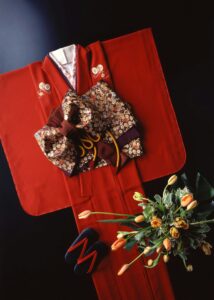
A kimono is constructed from a single bolt of fabric — the tan (反物) — roughly 12 meters long and 36 centimeters wide. The bolt is cut into eight pieces and reassembled without removing any material: every centimeter of the original bolt appears somewhere in the finished garment. This is not merely economical; it is a philosophical statement about material. Fabric, in the Japanese textile tradition, is understood as the product of an enormous amount of human labor — the cultivation of silk, the weaving, the dyeing — and it deserves treatment that acknowledges this. To cut fabric wastefully, to discard scraps, to let material go to nothing is to disrespect the labor embedded in it. The kimono’s construction ensures that nothing is wasted.
The result is a garment that fits not through cutting and tailoring to the individual body but through wrapping and folding — adjusting the length with a fold at the hip, adjusting the overlap of the front panels to accommodate different body shapes. This means that a single kimono can be worn by different people of different sizes. It also means that the garment exists in a different relationship to the body than Western tailored clothing: it does not shape itself to the body. The body shapes itself to it.
The Seasonal Calendar Encoded in Silk
Reading the Season in the Fabric
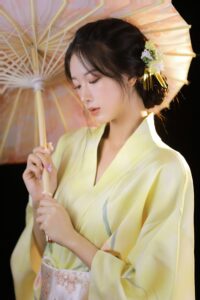
The kimono calendar is as precise as the agricultural one, and for connected reasons. The fabric weight and construction change with the season: summer kimono are woven of ro (絽) or sha (紗), gauze-like silk weaves that allow air to pass through; autumn and winter kimono are of heavier silk, sometimes padded with a cotton lining for warmth. The transition dates are formal and specific — single-layer unlined kimono (hitoe, 単衣) are worn in June and September, fully lined kimono (awase, 袷) from October through May, and unlined gauze (usu-mono, 薄物) in July and August. A kimono worn in the wrong fabric weight for its season signals inattention — not rudeness exactly, but a failure of the kind of calibration that the garment requires.
The motifs woven or dyed into the kimono carry seasonal information as well. Cherry blossoms appear in late winter and early spring, before the actual blooms — to wear them after the cherry season has passed is to be behind, seasonally speaking, in a way that anyone who understands the calendar will notice. Autumn grasses and insects belong to September and October. Snow crystals and pine motifs are appropriate in deepest winter. The appropriate choice is to wear motifs slightly ahead of their natural season — to look forward to what is coming rather than backward to what has passed. The kimono is a form of seasonal attention, worn on the body.
Social Information Woven Into Pattern
Formality Levels That Leave No Ambiguity
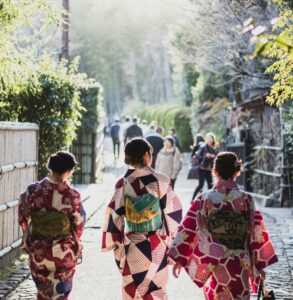
The kimono communicates social information with a precision that contemporary Western dress does not attempt. The number and placement of mon (紋) — family crests placed at specific points on the garment — indicate formality level immediately and unambiguously. A kimono with five crests is the most formal garment a woman can wear short of the traditional wedding kimono; three crests indicates semi-formal occasions; one crest is appropriate for formal but not the most solemn events. A kimono without crests is informal. A single glance at the back of a woman’s collar establishes the formality register she has chosen.
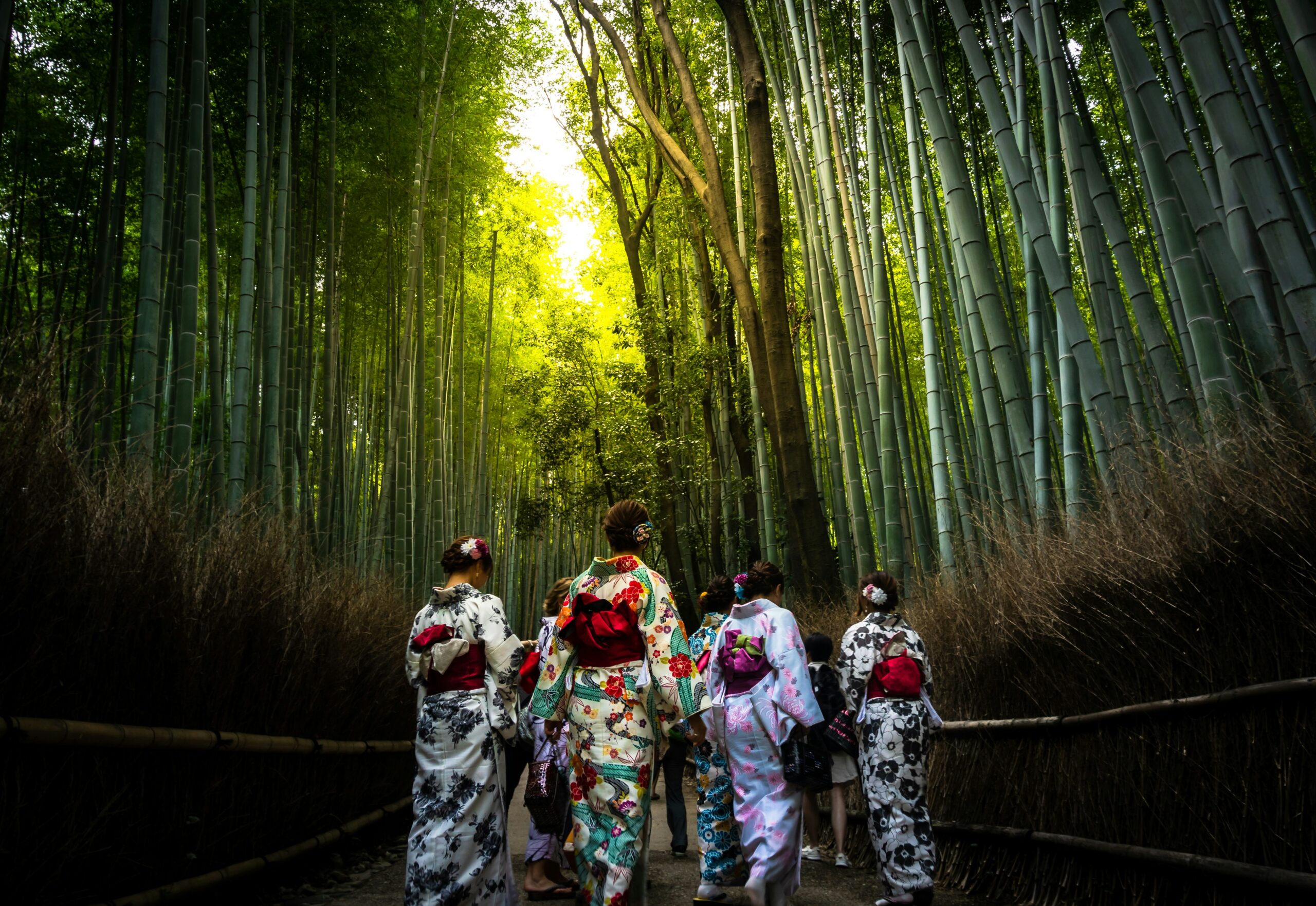
The obi (帯) — the wide sash wound around the waist and tied at the back — carries its own hierarchy of formality. The fukuro obi (袋帯), a long double-layer sash, belongs to formal occasions; the nagoya obi (名古屋帯) is standard semi-formal; the hanhaba obi (半幅帯) is casual. The style of the obi knot communicates the occasion as well as the obi itself — certain knot styles are for young unmarried women; others for married women; others for ceremonial occasions. An expert reading a kimono from across a room can extract significant information about the wearer’s status, age, and the occasion they are attending before exchanging a word.
The Crafts That Make the Kimono
The Many Hands in a Single Garment
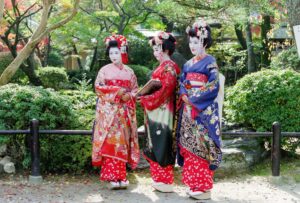
A high-quality kimono is not the product of a single craftsperson. It may involve a silk cultivator, a yarn spinner, a weaver working on a hand loom that has not changed significantly in two centuries, a yuzen (友禅) dyer who applies pigment through resist-dyeing techniques that require years of training, and an embroiderer who adds dimensional detail in gold thread. The care at each stage is total: the dyer who uses the Kyoto (京都) yūzen technique stretches the fabric on a long bamboo frame, applies the resist paste with a cone, paints pigments by hand, and steams the fabric to set the colors in a process that takes days for a single kimono length. The result — a fabric on which each motif is as precise as a painting — represents a concentration of craft attention that has no equivalent in industrial textile production.
The craft traditions that produce these materials are among Japan’s most endangered. The number of artisans capable of producing hand-woven Nishijin silk (Nishijin-ori, 西陣織), hand-dyed Kyoto yūzen, or Hakata-ori (博多織) obi fabric has declined sharply over the past century. Each craftsperson who retires without training a successor takes with them knowledge that cannot be reconstructed from documentation. The kimono-wearing population that sustained the demand for these crafts has shrunk; the crafts have shrunk with it.
The Body in the Kimono
What the Garment Does to Posture, Movement, and Attention
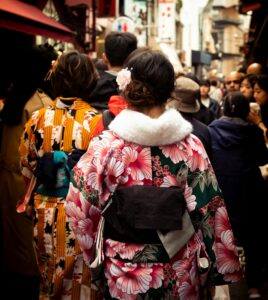
The experience of wearing a kimono is not the experience of wearing clothing that accommodates the body. It is the experience of allowing the body to be organized by the garment. The narrow foot-width of the hemline requires shorter, more deliberate steps; the long sleeves of formal furisode (振袖) kimono require a continuous awareness of what the arms are doing; the obi binds the torso in a way that makes slouching impossible and deep bending inadvisable. The garment teaches the body a different repertoire of movements — more contained, more deliberate, with a quality of presence in each gesture that ordinary clothes do not require.
The women and men who wear kimono regularly describe this effect as clarifying rather than constraining: the garment settles the body into a particular posture that settles the mind into a particular quality of attention. The same principle operates in the martial arts uniforms, the tea ceremony clothing, the No theatre costumes — all of the formal dress traditions of Japan share this characteristic: they shape the body toward a specific mode of being in the world, and the body so shaped finds that mode easier to inhabit. The clothes do not merely dress the body. They instruct it.
The kimono is declining as everyday dress — its complexity, its cost, and the knowledge required to wear it correctly have made it, for most Japanese people, a garment for special occasions rather than daily life. But the decline has not reduced its cultural weight. If anything, the rarity of kimono wearing has heightened the awareness of what is present when it is worn: that a person in kimono is carrying, on their body, a concentrated encoding of everything Japan has thought about beauty, time, propriety, and the relationship between the self and the world.