 You push aside the noren (暖簾) — the short fabric curtain that hangs in the doorway, indigo-dyed, the name of the place brushed across it in characters you may not be able to read — and step inside. The change is immediate and total. The cold or the heat of the street disappears. The smell hits you first: charcoal smoke, soy glaze, something rich and savory that you cannot immediately identify but that your body recognizes as food that was made with care and will taste exactly like it smells. Then the sound: a wave of conversation, laughter, the hiss of something hitting a hot grill, and over all of it, from somewhere near the kitchen, a voice calling out your arrival — “Irasshaimase!” (いらっしゃいませ!) — with a warmth and volume that makes the word feel less like a greeting and more like a welcome home. You have not been here before. It does not matter. The izakaya (居酒屋) has accepted you.
The izakaya is Japan’s after-work institution — the place where the formal structures of the day are officially permitted to relax, where the hierarchies and the careful speech and the composed faces of office culture are temporarily suspended in favor of cold beer, shared plates, and the particular relief of being among people who are also, finally, done for the day. It is not simply a bar that serves food or a restaurant that serves alcohol. It is something for which English has no precise equivalent: a social space with its own rules, its own culture, its own specific atmosphere that has been refined across centuries into the most welcoming environment that Japanese public life produces.
The Atmosphere: What the Room Does to You
A Space Designed to Make You Feel Better
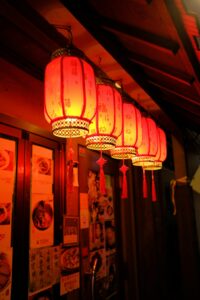
The interior of a great izakaya is a carefully constructed environment that presents itself as entirely unconstructed. The wooden beams overhead — darkened with years of smoke and steam. The paper lanterns casting the kind of warm, slightly orange light that flatters every face. The hand-written menu cards tacked to the wall at angles that suggest they were put up when needed and left where they landed. The small ceramic cups, mismatched, each one a slightly different shape. The noise — not the engineered ambient noise of a restaurant that has consulted a sound designer, but the genuinely accumulated sound of many people engaged in conversations they are enjoying, rising and falling in waves that make the room feel alive rather than loud.
This atmosphere is not accidental. It has been produced by centuries of refinement in what a space should feel like in order to perform the specific function the izakaya performs: the transition from the day’s formal self to something more honest and more relaxed. The lanterns outside — the red paper chochin (提灯) that mark an izakaya’s entrance as clearly as any sign — are the first signal. They glow in the evening in a way that is visually distinct from every other kind of establishment’s exterior lighting, warm and slightly hazy, readable from a distance as the particular kind of invitation that they represent. The wooden signboards, sometimes weathered, sometimes lacquered, sometimes chalked with the night’s specials in handwriting that suggests the chef wrote them personally — these communicate, before you have entered, that what is inside is handmade rather than manufactured, personal rather than corporate.
Inside, the smell is among the most immediately transporting sensory experiences in Japanese urban life. The yakitori (焼き鳥) grill — the charcoal fire over which skewers of chicken are cooking in various stages, the fat dripping and the glaze caramelizing and the smoke rising to the extraction hood above — produces a smell that is simultaneously ancient and completely of the present moment. It is the smell of protein and sugar over live fire, refined to its most appealing form. Combined with the dashi (出汁) stock that underlies much of the kitchen’s production, and the particular sharp sweetness of shoyu (醤油) sauce at high heat, the smell of an izakaya is a smell that people who have experienced it carry in memory for years. You encounter it on a street in another city — a yakitori place two doors down, perhaps, or a restaurant doing something with charcoal — and you are, for a moment, back in Japan, standing under a red lantern in the evening, exactly where you want to be.
Counter, Tatami, and Private Room: Three Ways to Be There
Each Seat Has Its Own World
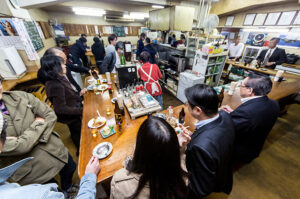
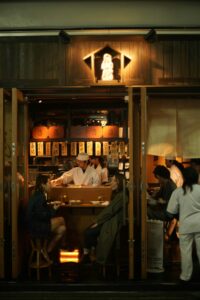
How you sit in an izakaya determines, to a surprising degree, what your evening will be. The counter seat (カウンター席, kaunta-seki) — a row of chairs or stools along the bar, directly facing the kitchen and the staff working it — is the most intimate configuration. You are close to the action: the grill, the knife work, the plating, the controlled chaos of a busy kitchen visible just an arm’s length away. The conversation that happens at izakaya counters is one of the form’s most distinctive features — the particular back-and-forth between customer and staff that develops over the course of an evening, organic and unhurried, the kind of exchange that is possible when both parties are in the same space for the same span of time and neither is in a hurry to move it toward any particular destination.
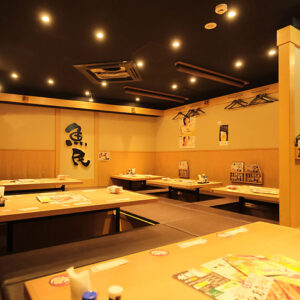
The zashiki (座敷) — the raised tatami seating area, where you remove your shoes at the step and sit on cushions at a low table — is the izakaya in its most Japanese form, and for groups it is ideal: the low table creates a closed world for the people around it, the cushions arranged so that everyone faces inward toward the shared plates, the removal of shoes marking a threshold between outside and in that is both practical and somehow ceremonial. Sitting seiza (正座) or cross-legged on a tatami cushion with a cold beer and a plate of edamame (枝豆) between you and someone you are glad to be with is one of the specific pleasures of Japanese social life, and it is a pleasure that does not diminish with repetition.
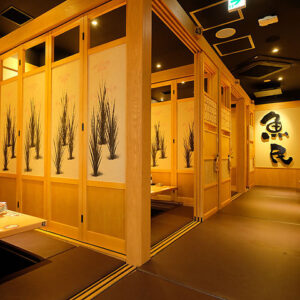
The private room (個室, ko-shitsu) — the enclosed space that larger izakaya often provide, with sliding screens or walls separating a group from the rest of the establishment — serves a different social function. It is where the conversation that cannot happen in an open room happens: the frank assessments, the unguarded opinions, the discussions that require privacy. Office groups often gravitate toward the private room, and the sliding door, once closed, functions as a kind of permission: what happens in this room stays here, and everyone present understands this without its being said.
The Food: Ritual, Smoke, and Shared Plates
Everything in Its Right Order
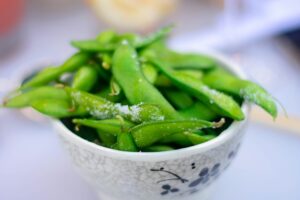
The edamame arrives first. Almost always. The boiled soybeans in their pods, salted, in a bowl, are the izakaya’s universal opening move — the food that appears as soon as you sit down with your first drinks, before you have had time to study the menu or decide what you want. They are not a starter in the Western sense. They are an acknowledgment that you have arrived and that the evening can begin. The act of eating them — popping the beans from their pods, eating while talking, the pods accumulating in the bowl — is a physical marking of the transition from the street to the izakaya, from the end of the workday to the beginning of the evening. No one ever remembers eating the edamame. Everyone has eaten it.
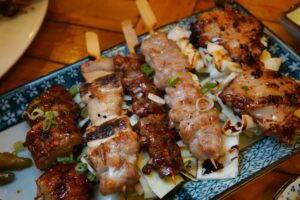
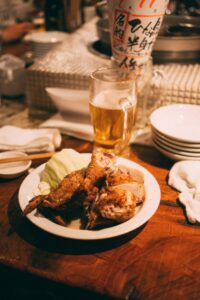
The yakitori that follows — skewers of chicken over charcoal, arriving in twos and threes throughout the evening, each representing a different part of the bird prepared in a different way — is where the izakaya kitchen shows what it knows. The variety within a single animal is extraordinary: thigh meat glazed with tare (たれ) sauce, salt-seasoned breast, cartilage with its snap and char, liver just barely cooked through, skin rendered and crisped, the small round meatballs (tsukune, つくね) that take the binding sauce differently from any cut. Each skewer is small enough to finish in two or three bites, which means the sharing is easy and the ordering is continuous — the table accumulating empty skewer sticks and full conversation as the evening progresses.
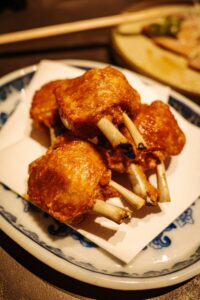
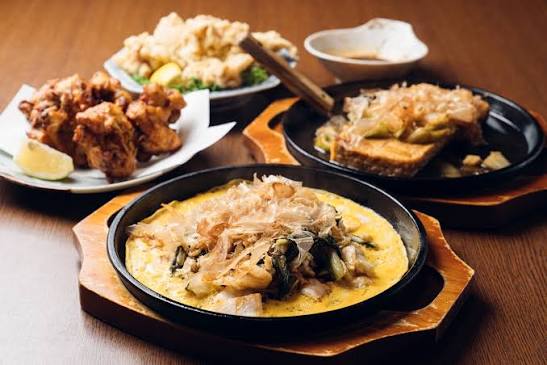
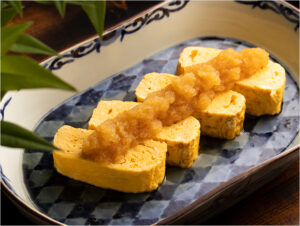
The other dishes of the izakaya menu are organized around the same principle: small, shareable, built for the pace of a drinking evening rather than the hunger of a main meal. The dashimaki tamago (だし巻き卵) — the rolled omelette made with dashi stock, soft in the center, the layers visible at the cut end — is a dish that reveals a kitchen’s technical standard immediately. Get it wrong and it is merely an egg dish. Get it right and it is a small demonstration of the patience and heat control that Japanese cooking demands at every level. The karaage (唐揚げ) — the fried chicken, marinated in soy and ginger, the crust shattering, the interior yielding — is what everyone orders and what everyone agrees about. The sashimi (刺身) plate, if the kitchen handles fish well, brings the sea into the room with a directness that no cooking can replicate.
Sharing is not optional at an izakaya. It is structural. The plates are sized for the table, not for the individual, and the logic of the menu — many small dishes rather than one large one per person — makes collective ordering the natural mode. What results is a continuous negotiation over the course of the evening: more of this, we should try that, someone wants another round of the chicken skin. The food becomes part of the conversation rather than a pause in it, and the combination of shared plates and shared cups and a table full of people who are genuinely interested in what is in front of them produces a quality of communal attention that is one of the most reliably pleasant social experiences available in Japan.
The Drinks: From the First Beer to the Last Round
Cold, Clear, and Perfectly Chosen
The first namabiiru (生ビール) — the draft beer, cold and immediately, condensation already forming on the glass before it reaches the table — is the pivot on which the izakaya evening turns. The temperature is important: Japanese draft beer is served colder than its European counterparts, cold enough that the first sip produces a physical sensation of cold traveling from the mouth downward, and that sensation is inseparable from the specific relief of the izakaya’s function. It is the physical correlate of the psychological shift the izakaya exists to produce. The relief is real. The beer knows this and performs accordingly.
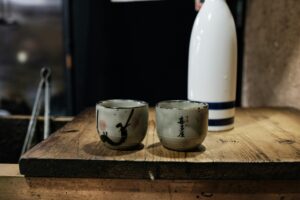
The sake (酒) culture of the izakaya runs deeper than the beer, though beer is what most people order first. A good izakaya carries sake from multiple regions, and the way the staff talks about it — the origin prefecture, the rice variety, the brewing style, whether it is best served cold or warm — reflects the same localism that organizes Japanese food culture generally. A cold junmai ginjo (純米吟醸) with the sashimi; a warm tokuri (徳利) of something earthier with the heavier dishes; the specific pleasure of the small ceramic cup, the ochoko (お猪口), that makes even a modest pour feel ceremonious. The glass, the vessel, the temperature — sake’s relationship with its container is part of its character in a way that Western wine culture has theorized about for decades and Japanese sake culture has simply practiced.
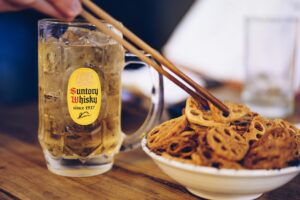
Shochu (焼酎) — the distilled spirit made from rice, sweet potato, barley, or other ingredients depending on the producing region — is the other great izakaya drink, and the one that most directly reflects regional identity. Kyushu has its sweet potato shochu culture; Okinawa has its awamori (泡盛). Diluted with hot water (oyuwari, お湯割り) in winter or with cold water and ice (mizuwari, 水割り) in summer, shochu is the drink that a certain kind of izakaya regular orders automatically, without looking at the menu, the same thing every visit, the order so established it barely needs to be spoken. The highball (ハイボール) — whisky and soda — completed its transition from retro curiosity to mainstream izakaya staple in the 2000s and is now ubiquitous: effervescent, easy, and specifically suited to the long pace of an izakaya evening that intends to continue for a while yet.
Honne and the Space Where People Become Themselves
What Happens When the Masks Come Off
Japanese social life is organized around a distinction that the language names explicitly: tatemae (建前), the formal face presented to the world, and honne (本音), the real feelings and opinions beneath it. The izakaya is, institutionally, the designated space for honne. This is not a side effect of the alcohol. It is the point. When the workday ends and the group moves to the izakaya — the transition marked by the specific phrase “otsukaresama deshita” (お疲れ様でした), the acknowledgment of shared effort that serves as both a closing of the work day and an opening of whatever comes next — the social contract governing the evening is different from the one governing the office. The hierarchy is not abolished, but it relaxes. The careful speech that the office requires loosens. The face that has been composed all day is permitted, within the izakaya’s walls, to become something less managed.
The nomikai (飲み会) — the drinking gathering that Japanese workplace culture has institutionalized as a regular social event — is one of the primary vehicles through which izakaya culture and work culture interact. The boss who seemed unapproachable across the meeting room table turns out, over yakitori and beer, to have opinions about baseball and a slightly embarrassing enthusiasm for a particular kind of sweet sake. The colleague you have worked alongside for a year but never really spoken to becomes, across a shared plate and a second round, someone whose company you are genuinely enjoying. The nomikai is not a forced performance of sociability. At its best, it is what the izakaya makes possible: the discovery of other people as people, rather than as roles, which the izakaya accomplishes through the ancient and reliable technology of good food, drink, and a room that is warm enough and lit just right.
The kanpai (乾杯) — the toast that opens the izakaya evening, glasses raised and touched, the specific moment at which the evening officially begins — is brief and sometimes perfunctory, but it marks something real. For the duration of the raised glass and the shared word, everyone at the table is in the same moment, oriented toward each other, and the izakaya’s social promise is briefly made explicit: we are here together, and that is worth acknowledging. What comes after the kanpai is the actual evening, unrepeatable and specific to this group in this place on this night. The izakaya provides the conditions. What happens within them is always different and, when it goes well, always slightly magical.
The One-Person Table: Drinking Alone as a High Art
The Counter Seat and the Pleasure of Your Own Company
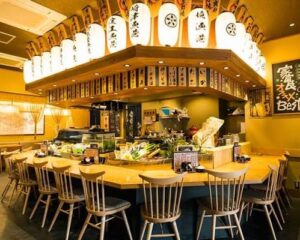
One of the izakaya’s least celebrated virtues is how hospitable it is to solitude. The single diner at a counter seat — ordering one skewer at a time, nursing a cold beer or a small flask of sake, watching the kitchen work — is not an anomaly in izakaya culture. He is a recognized type, a regular configuration, someone whose presence the staff understands and accommodates with a naturalness that the solo diner in other contexts often struggles to find. The counter is designed for this: the proximity to the grill, the visibility of the work, the organic possibility of conversation with the staff when both parties feel like it, the equal organic possibility of comfortable silence when they don’t.
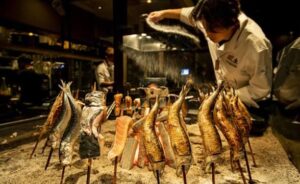
The master (大将, taisho) or mama-san (ママ) of a small izakaya — the owner-operator who is often also the head cook, the bartender, and the primary social presence of the establishment — is one of the great recurring figures in Japanese urban life. The relationship that develops between a regular and a good taisho over months and years of counter visits is a specific form of human connection: not friendship exactly, but something more than customer service, a mutual recognition that exists within the boundaries of the izakaya and finds its expression in the particular quality of attention that a good host brings to a guest they know well. The extra pour. The recommendation of something new that arrived from the supplier today. The comfortable silence that has no need to fill itself. These are not nothing. For the person who has had a difficult day, they can be the most sustaining encounter of the evening.
Old Wood and Standing Bars: The Varieties of the Form
Every Izakaya Has Its Own Character
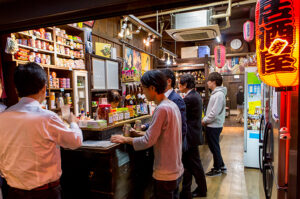
The Showa-era (昭和) izakaya — the old-style establishment that has been in the same location for forty or fifty years, the woodwork darkened with age, the menu written in a hand that has been writing it the same way for decades, the prices not significantly changed from what they were in 1985 — is the form that exerts the strongest pull on the imagination, and for good reason. These places carry the accumulated atmosphere of all the evenings they have hosted: the voices, the smoke, the specific quality of ease that a room acquires when it has been making people comfortable for a long time. The regulars who have been coming since their thirties are now in their seventies. The staff who were young when the place opened are now old. The izakaya itself is unchanged.
The specialist izakaya — the yakitori-ya (焼き鳥屋) that does nothing but chicken over charcoal; the kaisendon (海鮮丼) place near the harbor that has the fish delivered each morning and knows exactly one thing about it — represents the izakaya form at its most focused. These establishments do not need to offer variety because they offer mastery instead, and in Japan the mastery of a single thing pursued for a long time is understood as a value in itself. The yakitori specialist who has been tending the same style of charcoal grill for thirty years knows things about the relationship between heat and chicken that no general menu can accommodate, and the regulars who come to these places come specifically for that knowledge, expressed in what lands on their skewers.
The tachinomi (立ち飲み) — the standing bar, with no seating, customers standing at narrow ledges along the wall or around small high tables — is the izakaya stripped to its essential function. No comfort, no atmosphere to speak of, nowhere to settle in for the long haul. Just a glass, a plate, a few minutes between work and the train home, a conversation that might last twenty minutes or an hour and a half depending on what develops. The tachinomi is the democratic form of the izakaya: cheap, brief, open to everyone, requiring nothing but the desire to stop for a moment in the day’s passage from work to home. In the evenings around train stations in Tokyo, Osaka, and every other Japanese city, the tachinomi lights come on and the people stop, and for a short time the station concourse and the street and the blur of the commute give way to a small space of stillness and company.
From Hokkaido to Hakata: Japan’s Regional Izakaya Cultures
The Country’s Food Identity, One Establishment at a Time
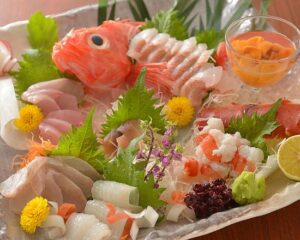
Hokkaido (北海道) izakayas are about the sea, because Hokkaido is about the sea. The seafood in Sapporo and Hakodate and the coastal towns — the crab, the uni (sea urchin), the ikura (salmon roe), the hokke (a local atka mackerel, split and grilled over fire) — is not merely better than what the rest of Japan offers; it is of a different category, the product of cold northern waters and fishing traditions that have been practiced in the same places for generations. A Hokkaido izakaya in February, with the snow deep outside and the grilled seafood arriving hot from the kitchen and the local sake cold in the cup, is a seasonal experience as specific and unrepeatable as any Japan offers.
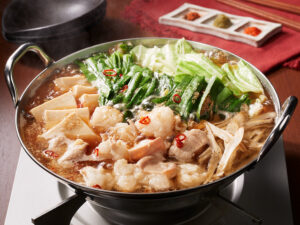
Fukuoka (福岡) — Hakata, specifically — has its own izakaya culture organized around offal in a way that the rest of Japan does not quite replicate. The motsunabe (もつ鍋) — the hot pot of beef offal, cabbage, and leek in a rich soy or miso broth — is the dish that Hakata izakayas are known for nationally, and eating it in the city that perfected it, in a place that has been making it for decades, is a different experience from the same dish in Tokyo. The city’s relationship with ingredients that other Japanese food cultures treat as secondary or avoided entirely gives Hakata’s izakaya scene a directness and an intensity that visitors find bracing. The flavors are not delicate. They are emphatic. They are the flavors of a port city with centuries of trade and appetite behind it.
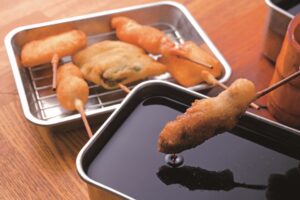
Osaka’s (大阪) izakaya culture is organized around the principle of kuidaore (食い倒れ) — eating to the point of happy excess, spending freely on good food without regret — and the city’s takoyaki (たこ焼き) and kushikatsu (串カツ) establishments, technically more street food than izakaya but operating in the same social register, bring to the izakaya form the specific Osaka quality of pleasure taken seriously. Tokyo’s izakaya culture is vast and various — the capital absorbs all regional styles while producing its own, particularly the yakitori culture of the train station back-alleys (yokocho, 横丁) where low-ceilinged bars pack together under the elevated tracks and the evening is conducted in a warm fug of charcoal smoke and proximity that the city’s scale otherwise makes impossible.
The Ending: 締め and the Art of the Perfect Last Course
The Right Way to Close an Evening
The shime (締め) — the closing dish, the final food of the izakaya evening — is a Japanese institution as considered and deliberate as the kanpai that opened it. After hours of small plates and drinks, the stomach wants something that will settle it, that will provide a satisfying conclusion to the evening’s consumption and prepare the body for the journey home. The shime is the answer to this need, and different regions and establishments offer different versions of it.
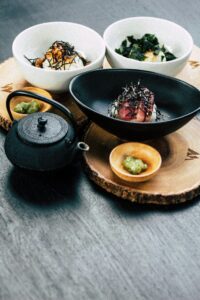
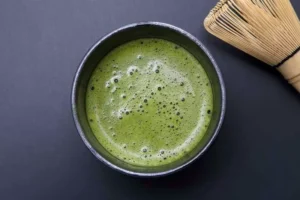
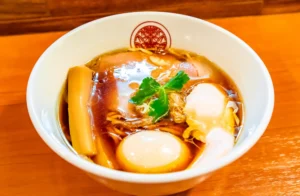
The shime ramen (締めラーメン) — a bowl of noodles at the very end of the evening, after all the beer and sake and yakitori — is the most widespread form. The logic is sound: the warm broth absorbs whatever has preceded it, the noodles are gentle on a stomach that has been working all evening, and the act of eating a bowl of ramen at midnight in a slightly bleary state with the people you have spent the evening with is one of the specific pleasures of Japanese nightlife that has no real equivalent elsewhere. In Kyoto, the shime might be ochazuke (お茶漬け) — hot green tea poured over rice, with pickles — a dish of supreme simplicity that manages, in this context, to taste like exactly the right thing. In Fukuoka, a bowl of the city’s own ramen, tonkotsu broth rich and white, serves as both shime and tribute to where you are.
The okawari (おかわり) — the refill, the extra order, the “one more” that extends the evening by another round — is the izakaya’s way of not wanting to end. The culture of sharing and refilling, of the table that is never quite finished, is part of what makes the izakaya different from a place you go to eat a meal and leave. It is a place you go to spend an evening, and the evening’s length is determined by how much you are enjoying it, which is the right way to measure an evening. When the group finally signals for the bill — the outstretched arm, the gesture that approximates writing — the o-hiraiki (お開き), the closing, begins: the coats retrieved, the thanks given to the staff, the shoes at the tatami threshold, the noren brushed aside on the way out. The night air is cold or warm depending on the season. The street is the same street it was when you arrived, but you have crossed some interior distance since then, and the walk to the station has a different quality from the walk that brought you here. This is what the izakaya does. It gives the evening somewhere to go, and sends you home different from how you arrived.
The noren hangs in the doorway every evening, waiting. The lantern is lit. Somewhere inside, a grill is hot, the first orders are going in, and someone is about to have the best two hours of their day. This is what Japanese food culture tastes like when it is not trying to impress anyone — when it is simply trying to make people feel at home, which is the hardest thing to do and the thing the izakaya has been doing better than anywhere else for centuries.
The same care and seasonality that defines the izakaya table runs through every aspect of Japanese food culture — from the ramen bowls of Fukuoka and Sapporo to the kaiseki dinners of Kyoto.