The drum starts before dawn. Long before the first wrestler steps onto the clay, before the salt is thrown or the referee takes his position, the taiko (太鼓) drum at the Kokugikan (国技館) begins its morning call — a deep, resonant beat that carries through the streets of Ryogoku for several kilometers in every direction, announcing to the neighborhood and to anyone who knows what it means that today is a day of sumo. You hear it before you understand it. Then, sitting inside the hall for the first time, watching two men in the heavy silence of their pre-bout ritual — the staring, the salt throwing, the synchronized lowering into position — the sound of the drum and the sight before you suddenly organize themselves into a single coherent thing, and you understand that you are not watching a sport. You are attending a ceremony that has been performed, in this form, for fifteen centuries, and that is still, unmistakably, sacred.
Sumo (相撲) is the oldest of Japan’s organized athletic traditions and the one most thoroughly saturated with Shinto (神道) ritual. The technical description of the contest — two wrestlers attempting to force each other out of a clay circle or to the ground — gives almost no information about what sumo actually is. What sumo actually is, is an extended act of worship in athletic form: a ceremony in which the human body, trained to its extreme limit, becomes the instrument through which the divine is invoked, acknowledged, and honored. The sport and the ritual are not separate things. They have never been separate. Understanding sumo means understanding that the circle on the clay floor is not a playing field. It is a sacred space, and everything that happens within it — from the smallest gesture to the most violent collision — is an act performed in relation to that sacredness.
The Dohyo: A Sacred Space Suspended Between Worlds
The Circle That Is Also a Shrine
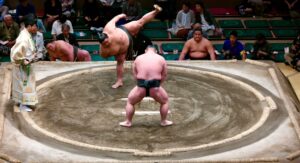
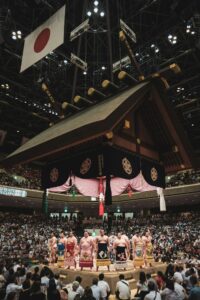
The dohyo (土俵) — the ring in which sumo is contested — is not a ring in the sense that boxing or wrestling uses the word. It is a raised platform of clay, compacted over days into a surface of considerable hardness, with a circle approximately 4.55 meters in diameter defined by buried rice-straw bales. Before each tournament, the dohyo is constructed from scratch by the yobidashi (呼出し) — the attendants who perform multiple ceremonial functions throughout the tournament — and its construction is preceded by a Shinto ceremony in which offerings including salt, kelp, dried cuttlefish, chestnuts, and a bottle of sake are buried beneath the center of the ring. The ground beneath the dohyo is consecrated before any wrestler steps onto it. The construction itself is a sacred act.
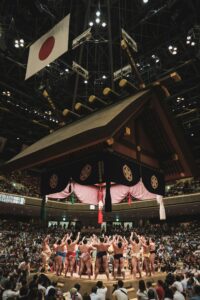
Suspended above the dohyo, hanging from the ceiling of the Kokugikan on four cables, is the yakata (屋形) — a roof structure in the style of a Shinto shrine. Its design is modeled on the architecture of the Ise Jingu (伊勢神宮), Japan’s most sacred Shinto complex, and its four corners are hung with tassels in colors representing the four cardinal directions and their associated divine guardians: blue for the east, white for the west, red for the south, and black for the north. The roof transforms the dohyo from a sporting arena into a shrine interior — a defined sacred space within which the rules of the ordinary world are temporarily suspended and the rules of the divine world take precedence. When two wrestlers meet beneath it, they are meeting in a space that has been consecrated, architecturally and ritually, as a place where the human and the divine come into contact.
The clay of the dohyo is considered sacred throughout the duration of the tournament, and the traditions around who may and may not touch it reflect this understanding. Women have historically been prohibited from entering the ring — a rule rooted in Shinto concepts of ritual purity — a prohibition that has generated considerable public debate in recent decades and that illustrates, precisely, how seriously the ring’s sacred status is maintained. The dohyo is not a metaphorically sacred space. It is, within the framework of sumo’s ritual world, an actually sacred space, and the traditions surrounding it are maintained with the seriousness appropriate to that status.
Salt, Stomping, and the Purification of the Ring
Every Gesture Is a Prayer
The pre-bout ritual in sumo is longer than the bout itself. A top-division match may be decided in three seconds; the ritual preceding it unfolds over four minutes of gathering tension that is, for those who understand what they are watching, one of the most riveting performances in any sport on earth. Its elements are not theatrical devices. Each is a discrete act of purification and invocation with roots in Shinto practice.
The salt throwing — the moment that has become sumo’s most immediately recognizable image — is a purification ritual. Salt in Shinto practice is a purifying agent, used at shrines and in ceremonies to ward off impurity and invite the presence of the kami (神), the divine spirits of the Shinto world. When a wrestler walks to the edge of the dohyo and hurls a handful of salt into the air above the ring — the salt catching the arena lights for a moment before falling — he is not performing for the crowd. He is purifying the space where the contest is about to occur, making it fit for an act that is, in the sumo framework, performed in the presence of the divine. The salt marks a transition: before the throw, the ring is ordinary. After it, the ring is prepared.
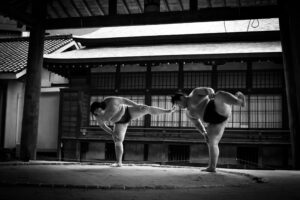
The shiko (四股) — the ritual stomping exercise that wrestlers perform as part of their warm-up and that appears in highly stylized form during the pre-bout ceremony — has a meaning that its visual form makes immediately legible: the feet strike the earth with force and deliberate weight, and what they are striking out is evil spirits. In Shinto belief, evil spirits inhabit the ground, and the ceremonial stomping drives them down and away, purifying the earth on which the contest will take place. The shiko is therefore not a warm-up exercise that happens to look ceremonial. It is a ceremony that happens to also prepare the body. The distinction matters. Sumo does not layer ritual onto sport. It contains sport within ritual.
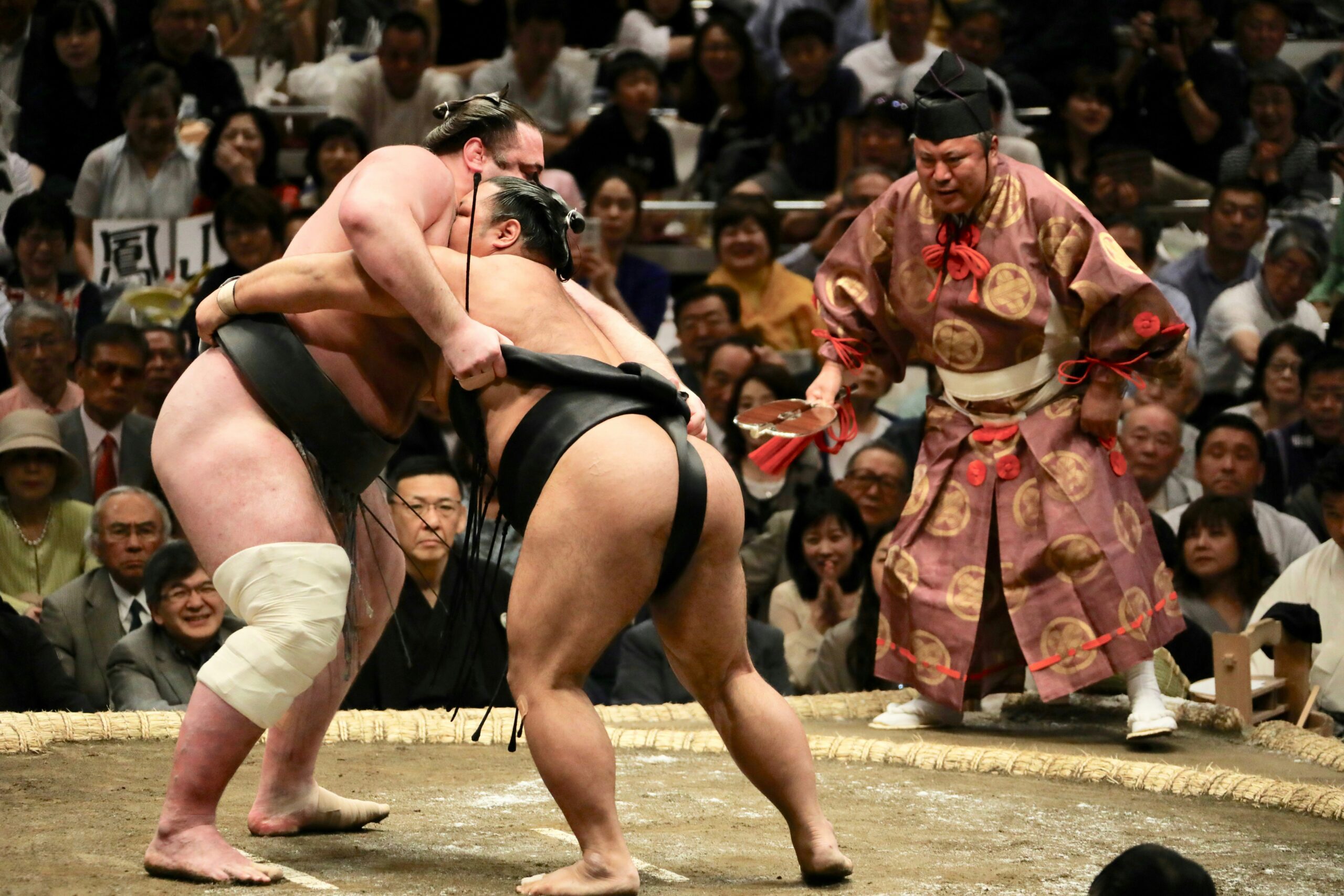
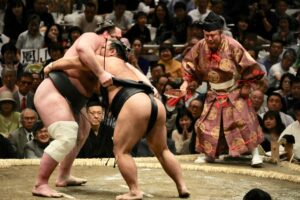
The leg-spreading crouch — the shikiri (仕切り) — in which both wrestlers lower into their starting position and stare at each other across the ring before rising, retreating, and beginning the sequence again, is the gathering of intent. The rules allow wrestlers to repeat this sequence multiple times before the final crouch from which the bout begins. What happens in this silence — the two men staring at each other across a distance of less than two meters, each reading the other, each gathering the focus that the moment demands — is one of the most psychologically intense experiences in sport. The crowd, enormous and loud moments before, goes absolutely quiet. The drum has stopped. The referee is still. Everything waits.
Dohyo-iri: The Grand Entrance That Stops Time
When the Wrestlers Walk In as Gods
Each day of a sumo tournament, before the top-division bouts begin, the wrestlers of the two competing stables perform the dohyo-iri (土俵入り) — the ring-entering ceremony. In the upper division, the makuuchi (幕内), this ceremony takes place twice: once for the wrestlers aligned with the East side, and once for those aligned with the West. The wrestlers enter in order of their ranking, moving in procession from the locker area to the arena, each wearing the kesho-mawashi (化粧廻し) — an embroidered ceremonial apron worn only for this ceremony and replaced by the fighting mawashi (廻し) for the bouts themselves. The kesho-mawashi are objects of extraordinary craftsmanship: heavy silk, embroidered with designs that can take months to produce, representing the identity and affiliations of the wrestler who wears it. Some are gifts from sponsors; some are heirlooms of the stable. All are treated as the ceremonial garments they are.
The wrestlers arrange themselves around the dohyo, facing outward toward the crowd, and perform a synchronized sequence of ritualized movements — the clapping, the arm-spreading, the turning — that acknowledges the sacred space they are entering and the divine forces present within it. The ceremony is brief, perhaps three minutes, but the accumulated presence of the wrestlers — the largest men you have likely ever seen gathered together in a single room, each in his ceremonial apron, each performing the same movements — produces an effect that is genuinely overwhelming. The procession has the quality of a religious pageant, which is precisely what it is.
The mawashi itself — the thick silk belt, folded multiple times, that constitutes the wrestler’s only garment during competition — carries a significance beyond its practical function as the thing one’s opponent attempts to grip. Its color in competition (a dark, formal tone for lower ranks; increasingly elaborate for higher ranks) marks position within the hierarchy. Its care and maintenance are part of a wrestler’s personal ritual. The mawashi is not washed during a tournament — superstition, and also a form of material continuity with the performances it has already witnessed. In the highest reaches of the sport, a wrestler’s mawashi is among his most significant possessions, an object that has absorbed the history of his career.
The Rikishi: Athletes Who Live as Servants of Tradition
The Life That the Ceremony Requires
A rikishi (力士) — a sumo wrestler — does not simply practice a martial art. He inhabits a total institutional world that has changed relatively little in centuries and that is organized, at every level, around the transmission of tradition. From the moment a young man enters a sumo stable (heya, 部屋) — typically in his mid-teens, often from a background that has no connection to sumo — his life is restructured entirely around the demands of the sport and its associated culture. He wakes before dawn for training. He eats the communal meal (chankonabe, ちゃんこ鍋) that has fed wrestlers for generations. He wears traditional Japanese clothing — the yukata (浴衣) or hakama (袴) — in public at all times. He maintains the chonmage (丁髷), the topknot that has been the mark of the sumo wrestler for centuries and that distinguishes him, instantly and visibly, as a member of this world.
The stable is hierarchical in a way that reflects both sumo’s feudal origins and its continued insistence on the values of seniority, respect, and mutual obligation. Junior wrestlers serve senior wrestlers, clean the facilities, and are last to eat and last to sleep. The severity of this hierarchy can seem extreme from the outside; from within the sumo world, it is understood as the necessary condition of the transmission that makes the tradition viable. You cannot learn what sumo requires through instruction alone. You learn it by living inside the world that produced it, absorbing through daily experience the postures, the courtesies, the timing, the relationship to space and silence and other bodies that no curriculum can teach.
The discipline extends to how a wrestler moves through the world outside the stable. The bow of greeting, the manner of speech toward seniors, the conduct at public appearances — all are governed by expectations that sumo’s traditions maintain with considerable seriousness. A wrestler who behaves inappropriately in public brings shame not only on himself but on his stable master, his stable’s history, and on the sport itself. The rikishi is never simply himself. He is a representative of an institution, and the institution is one that has been representing something beyond sport for fifteen hundred years. The weight of that representation is real, and the wrestlers who carry it longest and best are recognized as having understood, at a level deeper than technique, what sumo actually is.
The Yokozuna: The Weight of the Highest Title
A Rank That Cannot Be Revoked, Only Retired
The yokozuna (横綱) — the grand champion, the highest rank in sumo — is the most demanding title in Japanese sport, and possibly among the most demanding in any sport in any tradition, for a reason that has nothing to do with athletic performance and everything to do with what the rank means. A yokozuna is promoted when the sumo governing body determines that a wrestler has achieved a standard of excellence and dignity that makes him worthy of representing sumo at its highest level. The promotion is not reversible. Unlike every other rank in sumo, which rises and falls with performance, the yokozuna rank once granted cannot be taken away — but it can become an unbearable weight, because a yokozuna who loses too often is expected to retire rather than compete at a level below the dignity of the rank. The title does not protect its holder. It obligates him.
The yokozuna’s dohyo-iri is performed separately from those of other wrestlers and constitutes the most visually powerful ceremony in sumo. Wearing the tsuna (綱) — the thick rope belt from which the rank takes its name, woven in a pattern specific to the wearer’s style and containing a fixed number of hemp strands — the yokozuna performs a solo ceremony on the dohyo in which the shiko stomping reaches its fullest, most deliberate expression. The leg rises to full height and descends with full force; the arms spread wide; the posture communicates, without ambiguity, the presence of an athlete at the absolute limit of what human physical cultivation can produce. The ceremony lasts perhaps two minutes. In those two minutes, watched by several thousand people in absolute silence, the yokozuna enacts what sumo has always been trying to say: that the human body, fully trained and fully present, is a sacred instrument, and that what it is doing here, in this ring, beneath this roof, is a form of prayer.
The yokozuna has worn the tsuna since the eighteenth century, when the first formal ceremonies of investiture were established. Before that, the great wrestlers of sumo’s earlier history were celebrated without this specific ritual apparatus, though the concept of a supreme wrestler was ancient even then. The tsuna connects every holder of the rank to every previous holder across three centuries of recorded history — a material link, worn on the body, between the present and a past that sumo takes seriously as a living inheritance rather than an archival one.
Inside the Kokugikan: The Atmosphere That Cannot Be Described
What the Room Does to You
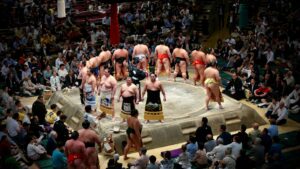
The Kokugikan (国技館) — the National Sumo Hall in Ryogoku, Tokyo — holds approximately eleven thousand people, and on the final days of a Tokyo tournament it is full. The building has the deep bowl shape of a venue designed for spectacle, but the quality of the atmosphere it produces is unlike any other sporting venue’s, because the event it holds is unlike any other sporting event. The early hours of each tournament day — when lower-division wrestlers compete before sparse crowds in the quiet of a nearly empty hall — have a meditative quality that the packed final-day sessions do not. Both are valuable. Both are part of what sumo is.
The masu-seki (升席) — the square box seats that fill the arena floor — are a specifically Japanese institution, a seating arrangement designed for groups of four who share the cushioned space, sitting cross-legged at floor level, eating and drinking throughout the day in a configuration that turns the tournament into something between a sporting event and a communal meal. The combination of proximity to the dohyo (the nearest seats are perhaps five meters from the ring’s edge), the low viewing angle, and the intimate scale of the masu-seki produces a relationship between spectator and event that stadium seating cannot replicate. You are not watching from above. You are present at floor level, sharing the space with everyone around you, and the wrestlers when they pass are at eye level and extraordinarily close.
The yobidashi — the attendants who perform the ring-calling ceremony, sweeping the dohyo between bouts, carrying the kensho (懸賞) banners, and managing the tournament’s ceremonial functions — are essential figures in the atmosphere of a sumo day. The kensho banners — the flags of corporate sponsors, carried in procession around the ring by a running yobidashi before a high-profile bout — create a spectacle that is simultaneously ancient in form and contemporary in content: the same circuit of the ring that has been made for centuries, now carrying the logos of electronics companies and noodle manufacturers. The disconnect is somehow entirely sumo: the ritual persists in its form regardless of what content fills it, because the form is the point.
The drum call at the start of each tournament day — the yagura-daiko (櫓太鼓), performed on a raised platform outside the Kokugikan by a yobidashi who has trained for this specific role — is the moment the sumo day begins its existence in the world. The particular rhythm, the particular sound of the drum in the morning air of Ryogoku, carries through the streets and enters people’s awareness before they have consciously decided to attend to it. It is an alarm clock for a community and an invocation for an event. When it stops, the day has officially started. Inside the hall, something shifts.
Six Tournaments, Six Seasons: Sumo Through the Year
The Calendar of Sacred Time
The six grand tournaments — the honbasho (本場所) — that constitute the sumo calendar are distributed across the year in a pattern that gives each a seasonal character. Three are held in Tokyo: at the Kokugikan in January, May, and September. The others travel to Osaka in March, Nagoya in July, and Fukuoka in November. Each location carries its own tradition, its own local audience, its own accumulated weight of history in that city’s relationship with sumo.
The hatsu basho (初場所) — the New Year tournament held in January at the Kokugikan — carries the character of its season. January in Japan is the month of new beginnings, of first visits to shrines, of the particular quality of winter light on a day when the year has just turned and everything feels, briefly, full of possibility. The hatsu basho begins in this atmosphere and is suffused with it: the wrestlers performing their ceremonies in the cold air of a building that has been silent for six weeks, the audience arriving in formal winter dress, the whole event carrying the gravity of a year’s first ceremony. To attend the hatsu basho is to participate in the ritual structure of the Japanese year at one of its most concentrated points.
The regional tournaments bring sumo into direct contact with local culture in a way that the Tokyo events do not quite replicate. Osaka’s long tradition of commercial culture gives its tournament a particular energy. Nagoya’s summer heat — the July tournament is held in the hottest month of the year, in a city where summer is genuinely extreme — produces a quality of sweat and effort and atmosphere that the climate of Tokyo in January simply cannot match. Fukuoka in November, with the academic year winding down and the autumn colors at their peak, has its own local devotees who have attended every November tournament within memory. Sumo travels through Japan the way a festival tradition travels — carrying the same ritual from place to place, encountering each place’s own character, and leaving behind a layer of history each time.
Sumo in the Modern World: Foreign Wrestlers and Living Tradition
What Changes and What Does Not
The arrival of foreign wrestlers in the upper levels of professional sumo — a development that began in earnest in the 1990s and that has accelerated in the decades since — is the most discussed transformation in the sport’s recent history, and its consequences have been more complicated than either critics or supporters initially predicted. The wrestlers who have come from Mongolia, Georgia, Eastern Europe, and other countries without sumo traditions and reached the highest ranks have, in some ways, transformed what the sport looks like from the outside: the yokozuna rank, once exclusively Japanese, has been held for extended periods by Mongolian wrestlers whose dominance on the dohyo was absolute. This produced, in the Japanese sumo audience and the sumo establishment, a complex mixture of admiration and anxiety that has not fully resolved.
What the foreign wrestlers have not changed — and this is the more interesting fact — is sumo itself. The wrestlers who have succeeded at the highest levels have done so by absorbing the tradition with the seriousness it demands: learning Japanese, living within the stable system, mastering the ceremonial requirements, understanding that sumo is not separable from the world that produced it. The Mongolian wrestlers who became yokozuna performed the yokozuna dohyo-iri with the full weight the ceremony requires, not because they were obligated to but because they understood, having trained within the tradition, what the ceremony was. Sumo absorbed its foreign practitioners rather than being changed by them, which is perhaps the strongest possible evidence that its core is what the tradition has always claimed it to be: not a technique that can be extracted from its context, but a way of being in relation to a sacred practice that changes those who enter it.
For contemporary Japanese audiences, sumo occupies a role that is partly sporting, partly cultural, and partly nostalgic in the deepest sense — a nostalgia not for a personal past but for a shared national one. The image of a family gathered around a television set for the afternoon sumo broadcast — the familiar tournament music, the familiar ceremonial rhythms, the grandmother who knows every wrestler’s name and has opinions about every bout — is a specifically Japanese cultural memory, shared across generations, that the sport continues to generate even as the media landscape around it transforms. The NHK (日本放送協会) sumo broadcast has run for decades and carries with it the accumulated weight of all the afternoons it has filled. When the drum plays and the cameras find the ring, something older than television is still present in the room.
The bout itself, when it finally comes, is over very quickly. Three seconds, sometimes less, the two bodies colliding and resolving into an outcome that the whole preceding ritual has been building toward. But it does not feel short. It feels complete — the way a ceremony that has been properly prepared for feels complete — and the crowd’s response, the collective exhale and the burst of sound, has the quality of a congregation’s response to a rite that has been correctly performed. Then the salt is gathered up; the referee calls the next names; the drum begins again. The ceremony continues, as it has continued, across fifteen centuries of Japanese life — still sacred, still practiced, still meaning what it has always meant: that the human body, trained and present and offered up in the right spirit, is one of the ways in which something beyond the human makes itself known.
The Shinto ritual that animates sumo runs through much of Japan’s cultural life — from the sacred shrines of Kyoto to the ancient temples of Nara — and understanding sumo’s spiritual foundations opens every part of Japan’s ritual world a little further.