Shuri Castle: The Palace That Keeps Coming Back
A Royal Architecture Unlike Any Other in Japan
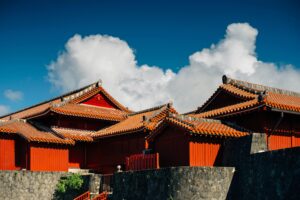
Shuri Castle (首里城) stands on a hill above the capital city of Naha (那覇), and the first thing you notice is that it does not look like a Japanese castle. Japanese castles are typically austere and vertical — grey stone, white plaster, steep rooflines designed to communicate defensive authority. Shuri Castle is red. The main hall, the Seiden (正殿), is lacquered in a deep Chinese red with gold decorative details, its curving roofline borrowed from the Chinese palace architectural tradition, its proportions grander and more ceremonial than military. The castle faces east — toward China, toward the rising sun, toward the sea routes that sustained the Ryukyu Kingdom’s prosperity. Every element of the architecture is a statement about what kind of civilization built it: one that looked outward, that absorbed influences from across the sea and synthesized them into something entirely its own.
The castle has been destroyed and rebuilt multiple times — most recently in a fire in October 2019 that destroyed the main hall and several surrounding structures just thirty years after the previous reconstruction was completed. The rebuilding is ongoing, and sections of the castle complex are accessible while the work proceeds. What this history of destruction and reconstruction reveals is not fragility but the opposite: the strength of the commitment, held across generations, to this building as the center of Ryukyuan cultural identity. Shuri Castle has burned and been rebuilt because the people of Okinawa have always decided that it must exist — that what it represents is worth the labor of building it again. The castle currently under reconstruction is the latest expression of that decision, made with the same conviction as every previous one.
Sefa Utaki: Where the Gods First Touched the Earth
The Most Sacred Place in the Ryukyuan World
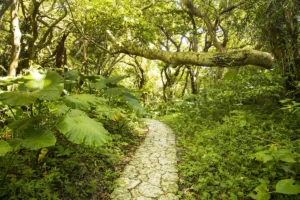
Sefa Utaki (斎場御嶽) sits on the southeastern coast of the main island, looking across the water toward Kudaka Island (久高島) — the island that Ryukyuan cosmology identifies as the place where the creator deity first descended to earth and began to make the world inhabitable for humans. An utaki is a sacred grove or sanctuary in the indigenous Ryukyuan spiritual tradition; Sefa Utaki is the greatest of them, the site where the highest-ranking female spiritual leaders — the noro (ノロ) — conducted the most important ceremonies of the kingdom, and where the Ryukyuan kings came to pray before undertaking matters of state.
Walking through Sefa Utaki is one of the most affecting experiences available in Okinawa, and it requires almost no prior knowledge to understand why. The path leads through a forest of ancient trees whose roots have grown over and through the limestone formations that define the site, and then through the triangular arch formed by two massive limestone rocks leaning against each other — an opening that frames, beyond it, the sea and the sacred island in the distance. The innermost chamber, where ceramic offering vessels still rest on the stone ledge, has the quality that the most genuinely sacred spaces always have: the sense that a particular quality of attention has been brought to this place, for a very long time, by many people, and that the accumulated weight of that attention is still present and perceptible. It is a UNESCO World Heritage Site, and the designation feels, for once, exactly right.
Kouri Island: The Blue That Has No Name
Crossing the Bridge Into Another World
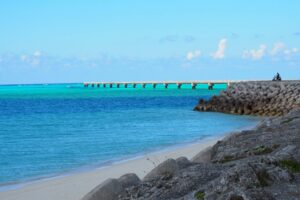
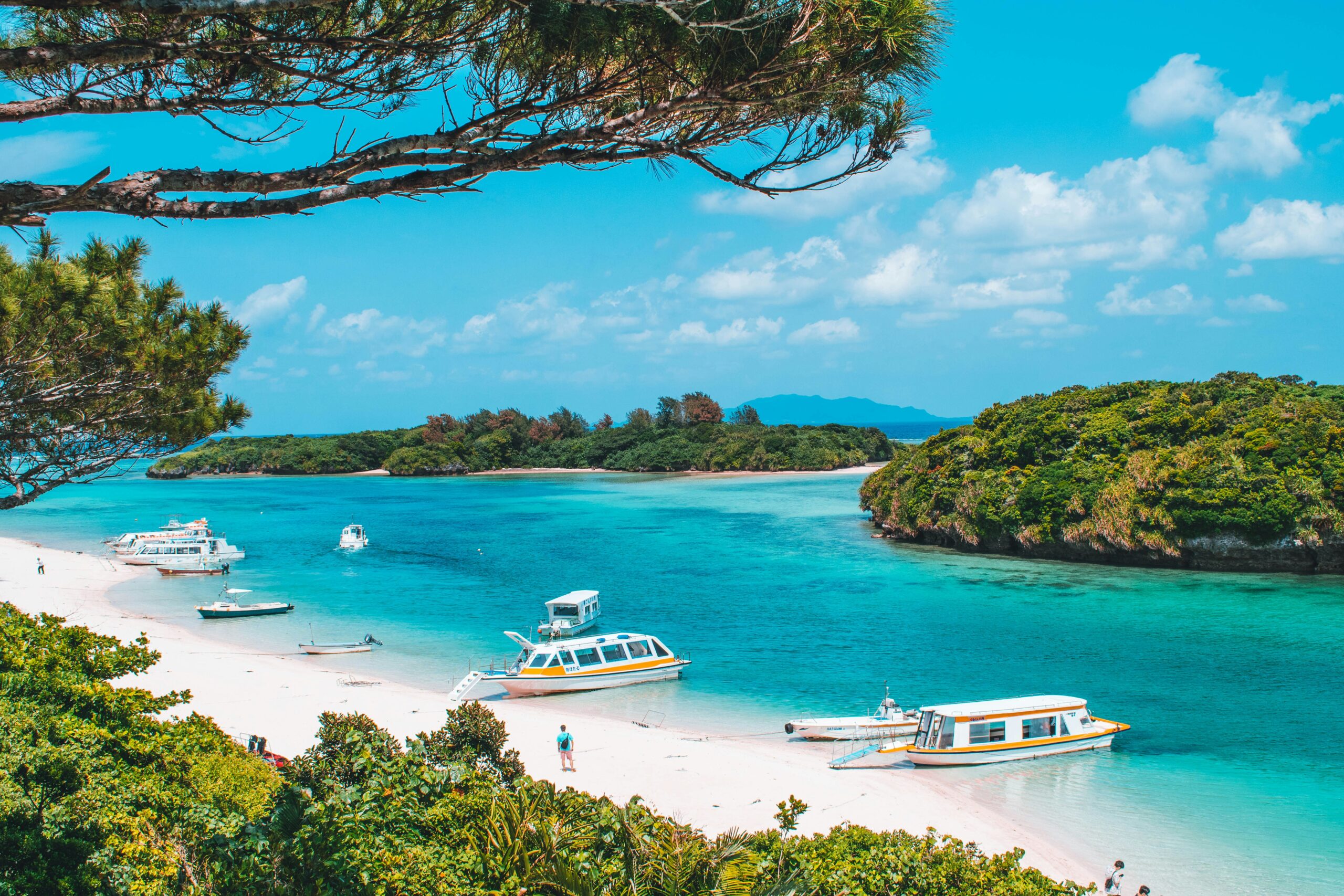
The bridge to Kouri Island (古宇利島) runs for nearly two kilometers over open water, and driving or cycling across it — the sea on both sides, the island rising green ahead — produces a specific feeling of threshold that is one of the best moments Okinawa offers. The water visible from the bridge is the color described in the opening of this piece, but here it is at its most concentrated: shallow enough for the white sand bottom to be visible, deep enough to produce full color, clear enough in the Okinawan light to seem to generate its own luminosity from within. The bridge deposits you on an island that can be circumnavigated in an hour, with beaches that receive morning light from one direction and evening light from another, and a character — quiet, unhurried, rooted in the sense that this particular piece of land has been considered special for a very long time — that the tourist infrastructure around it has not managed to entirely domesticate.
Kouri Island is identified in local tradition as the birthplace of the Ryukyuan Adam and Eve — the primordial couple from whom the island’s people trace their origin. The legend is appropriate to a place with this quality of concentrated, originary specialness. The beaches are extraordinary. The water is the thing. But what remains with you is the island’s sense of itself — the feeling, shared by a handful of places on earth, of being at a center rather than an edge, of being the place that other places are oriented toward rather than away from.
Churaumi Aquarium: The Ocean at Full Scale
The Kuroshio Sea Tank and What It Contains
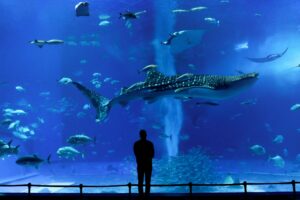
The Okinawa Churaumi Aquarium (沖縄美ら海水族館) in the Ocean Expo Park (海洋博公園) in northern Okinawa contains, in its main Kuroshio Sea (黒潮の海) tank, approximately seven and a half million liters of seawater, three whale sharks, manta rays, and a community of fish drawn from the Kuroshio Current that flows along Okinawa’s Pacific coast. The scale of the viewing panel — one of the largest acrylic panels in the world — produces an experience closer to standing at the edge of the open ocean than to looking at fish in an enclosed space. The whale sharks move through the water with a slowness that makes you aware, viscerally, of the weight of the water around them and the weight of the world above that water.
The aquarium’s name, Churaumi, means “beautiful sea” in Okinawan — not in Japanese, which would be utsukushii umi (うつくしい海). The choice of the Okinawan language for the name of a major national institution is deliberate and meaningful: it signals that the relationship between the Okinawan people and the sea around them is not the generic relationship of Japanese people to the ocean in general, but a specific, historically deep, culturally particular relationship that belongs to these islands and is expressed most accurately in the language that grew up here. The aquarium is not just a place to see marine life. It is a statement about whose sea this is and what that ownership means.
The Outer Islands: Miyako and Ishigaki
Where the Sea Reaches Its Purest Expression
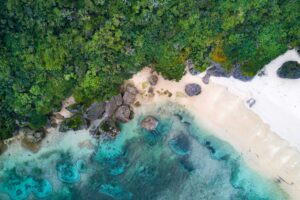
Beyond the main island, the Ryukyu archipelago extends southwest through over a hundred inhabited and uninhabited islands, the most celebrated of which are the Miyako Islands (宮古島) and the Yaeyama Islands (八重山諸島), anchored by Ishigaki Island (石垣島). These outer islands are where the Okinawan landscape reaches its most undiluted form: reefs of extraordinary biodiversity, beaches whose sand is composed entirely of the shells and skeletons of marine organisms rather than of ground rock, mangrove forests where the boundary between land and sea is negotiated in slow motion across the tidal cycles.
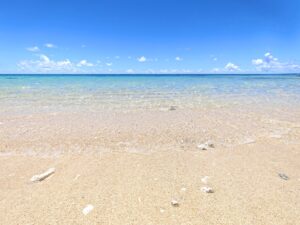
Miyakojima (宮古島) has beaches — Yonaha Maehama (与那覇前浜) among them — that are regularly cited among the most beautiful in Asia: a long, gradual descent into the sea over white sand, the water shading from near-clear at the shore through every gradation of blue-green to the deep blue of the open ocean at the reef edge. Ishigaki is the gateway to Iriomote Island (西表島), most of which is covered in subtropical rainforest that has no equivalent in the rest of Japan, where the Iriomote wildcat (イリオモテヤマネコ) — a species found nowhere else on earth — lives in the interior forest. The outer islands are not a simpler version of Okinawa. They are where the essential nature of the place, stripped of the mainland’s context and pressures, becomes most fully visible.
Kokusai Street: The Living Culture
Everything Okinawa Has Absorbed and Made Its Own
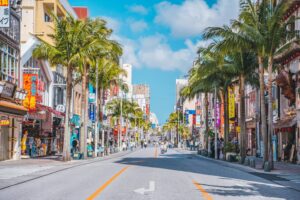
Kokusai Street (国際通り) — International Street — runs for just over a kilometer through the center of Naha and concentrates in a single thoroughfare the full cultural complexity of contemporary Okinawa. The street’s name dates from the postwar period, when the American occupation had made international contact a daily fact of Naha life, and the cultural layering it implies has only deepened since: shops selling Ryukyuan glass and shisa (シーサー) lion-dog guardian figures sit beside restaurants serving taco rice (タコライス) — a dish that arrived from the American military bases and became, within a generation, considered genuinely Okinawan food. The traditional craft shops with their bingata (紅型) dyed textiles and lacquerware exist alongside the contemporary fashion boutiques that have grown up around Okinawa’s surf culture.
Walking Kokusai Street with genuine curiosity — stopping to look at what is actually in the shop windows, eating at the restaurants that are clearly feeding the local lunch crowd rather than the tourist one, following the side streets into the residential neighborhoods behind the main drag — gives a picture of Okinawa that is more honest than any single narrative about the place can provide. It is a place that has survived colonial history, wartime devastation, American occupation, and Japanese prefecture status, and has emerged from all of it with a culture that is not seamless or simple but is genuinely and specifically its own. The street is where that culture does its daily living.
The Table: Okinawan Food as Philosophy
Bitter, Long-Cooked, and Alive
Goya champuru (ゴーヤーチャンプルー) is Okinawa’s most iconic dish, and its name is a small lesson in what Okinawan culture is. Goya is the bitter melon — a vegetable cultivated across Southeast Asia and prized in Okinawa for both its flavor and its medicinal properties, considered a fundamental element of the Okinawan diet for centuries. Champuru is an Okinawan word meaning “something mixed” — a word that also describes, without apology, the cultural character of the islands themselves. The dish is stir-fried bitter melon with tofu, egg, and usually pork, seasoned simply, eaten in the heat of the day with the understanding that the bitterness itself is part of the benefit. It is not a dish that tries to please everyone. It is a dish that offers you something specific and trusts you to appreciate it.
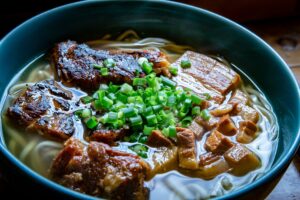
Okinawa soba (沖縄そば) is nothing like the buckwheat noodles that the word “soba” suggests on the Japanese mainland. The noodles are thick, wheat-based, slightly chewy — closer in character to the noodles of southern Chinese cooking than to anything in the Japanese noodle tradition — served in a clear pork-based broth and topped with a thick slice of rafute (ラフテー), the slow-braised pork belly that is perhaps the most emblematic single element of Ryukyuan cuisine. Rafute is braised for hours in a mixture of awamori (泡盛) — the Okinawan distilled spirit made from long-grain indica rice, aged in clay pots, with a flavor unlike any mainland Japanese sake — soy sauce, and brown sugar, until the pork is soft enough to yield to a chopstick’s pressure without resistance. The result is a richness that is the direct culinary expression of the Ryukyuan philosophy of taking the time that good things require.
The Okinawan table — built around pork, vegetables, the sea, and the fermented and slow-cooked techniques that the Ryukyuan Kingdom developed over centuries of agricultural and maritime life — has attracted serious attention from nutritionists for decades as one of the foundations of the longevity that the islands are famous for. Okinawa has one of the highest concentrations of centenarians in the world, and the diet is considered a significant contributor. But the more interesting thing about Okinawan food is not its nutritional profile but its character: it is food that is deeply local, that draws on ingredients and techniques specific to these islands and to the cultures that have influenced them, that tastes like nowhere else. It is a cuisine that knows what it is.
The Natural World: Banyan, Coral, and Stars
The Landscape That Holds Everything
The banyan tree — gajumaru (ガジュマル) in Okinawan — is the defining tree of the island landscape. Its aerial roots descend from the branches to the ground and then thicken into secondary trunks, so that a mature banyan occupies a space that seems disproportionate to any single tree’s right — an organism that has expanded outward into a grove while remaining one tree, its canopy spreading to shadow an area the size of a small park. In Okinawan tradition, the banyan is the home of kijimuna (キジムナー) — mischievous forest spirits, generally friendly but occasionally troublesome, associated with the sea and with fire. To sit under a large banyan in the late afternoon, when the light filters through the canopy and the roots make a landscape of their own around the base of the trunk, is to understand why the tradition of inhabiting the tree with spirits developed: it is easy, in that light, to believe that something lives in there.
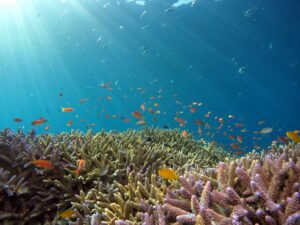
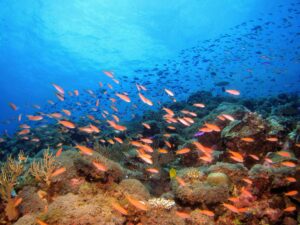
The coral reefs that ring the main island and extend throughout the Ryukyu archipelago contain some of the highest marine biodiversity in the waters around Japan — a consequence of the Kuroshio Current bringing warm, nutrient-rich water north from the tropics and the relative clarity of the water in the shallow reef areas. Snorkeling in the waters off the outer islands, above an intact coral garden, is one of those experiences that makes language inadequate: the density of life, the color of it, the silence under the surface broken only by the sound of coral and the movement of schools of fish — it is not a metaphor to say that this is another world. It is literally a different environment, operating by different physical laws, beautiful in a way that has nothing to do with human aesthetic categories and everything to do with the successful expression of life itself.
At night, away from the main island’s light pollution — on the beaches of Miyako or the interior of Iriomote or the shore of one of the smaller uninhabited islands — the sky above Okinawa reveals stars that the rest of Japan’s light-saturated urban landscape has hidden. The Milky Way is visible as a genuine structural feature of the sky rather than as a theoretical concept; individual stars cast visible light onto the water. The sky that the Ryukyuan navigators used to orient their trading ships is still there, unchanged, offering the same information it always has to anyone who stops long enough to look up at it.
Sanshin and Eisa: The Sound and the Movement
The Culture That Lives in the Body
The sanshin (三線) — Okinawa’s three-stringed instrument, cousin of the Japanese shamisen but distinct from it in construction, tuning, and the music it produces — is the sound of the islands. Its body is covered in python skin rather than cat skin, giving it a more resonant, rounder tone than the sharper shamisen; its tuning produces intervals that feel simultaneously ancient and immediate; the music played on it has a rhythmic forward momentum that is different from the more formal cadences of Japanese classical music. You hear the sanshin in Okinawa before you see it — drifting from restaurants, from the houses on the back streets of the island towns, from the festivals that happen throughout the year. It is not a performance instrument, or not only that. It is the sound of daily Okinawan life, played by people who learned from their parents who learned from theirs, in a transmission that has continued for five hundred years.
Eisa (エイサー) is the dance form associated with the Obon (お盆) period, when the spirits of the ancestors return to the world of the living and are welcomed, entertained, and guided back with ceremony and celebration. Eisa is performed by young men and women in groups, moving through neighborhoods to the sound of taiko drums and sanshin, the dance combining precise percussive footwork with the beating of hand drums carried by the dancers themselves. The energy of Eisa — the volume of the drums, the force of the movements, the collective momentum of a group of dancers moving in unison through a narrow street in the summer heat — is something that photographs do not convey. It is a physical event, felt in the chest as much as seen by the eyes, and it communicates, without words, something essential about what it means to welcome the dead back to the world: that it requires not solemnity but force, not quiet reverence but the full mobilization of the living body in honor of those who are no longer living in theirs.
The water is still that color when you leave — the color that requires a new word, the color of the sea around a place that arrived at its beauty and its culture by its own route, in its own time, from its own mixture of what the sea brought to it. Okinawa does not summarize easily. It is the coral reef and the royal palace and the bitter melon and the sanshin and the banyan tree and the memory of the war and the joy of the festival and the particular blue of the water in the morning light. All of it is here, simultaneously, in the same place, making a world that is genuinely unlike any other.
The independent spirit that shaped Okinawa’s culture is part of a broader story of Japan’s regional diversity — a story that continues northward through the islands, the ancient capitals, and the mountain towns, each one a different expression of what a civilization looks like when it has had the space to develop its own character.