Spring: The Tyranny and the Gift of Sakura
Ten Days That Organize Everything
The cherry blossom’s full bloom lasts, depending on location and year, approximately ten days. For those ten days, Japan undergoes a transformation that has no parallel in any other country’s relationship with a single plant. The sakura zensen (桜前線) — the cherry blossom front — advances northward from Okinawa through Kyushu, Honshu, and eventually Hokkaido over approximately two months, and its progress is tracked with the seriousness of a military advance. Weather forecasters report on it nightly. Office workers check the forecasts to schedule hanami (花見) parties. The specific park under the specific tree at the specific moment of fullest bloom is a point of almost competitive attention.
This collective fixation is not manufactured. It is the surface expression of a philosophical orientation that runs deep in Japanese culture: mono no aware (物の哀れ) — the pathos of things, the bittersweet awareness of beauty in the process of ending. The cherry blossom is the most concentrated embodiment of this concept in natural form. Its beauty is inseparable from its brevity. To watch the petals fall is to experience, viscerally, the truth that beauty cannot be held. The ten days of full bloom are more precious precisely because they are ten days and not the whole year.
New Beginnings in the Same Season
The Japanese academic and fiscal year begins in April — at the same moment as the cherry blossoms. This is not coincidence. The alignment of new beginnings with the season of renewal is a deliberate cultural choice, encoding in the structure of institutional life the understanding that human beginnings belong with natural ones. The student walking to school for the first time, the new employee arriving at the company entrance, the couple who chose an April wedding date — all of them are beginning against the backdrop of falling petals. The beginning is beautiful and the beginning is already ending. Both things are true simultaneously, and both are important.
Summer: Heat, Festival, and the Presence of the Dead
The Season of Noise and Spirit
Japanese summer is intense in a specific way: humid, hot, alive with the sound of higurashi (ひぐらし) cicadas in the evenings, and organized around festivals — matsuri (祭り) — that fill the calendar from June through August. The Gion Matsuri (祇園祭) in Kyoto, begun in 869 CE as a plague-purification ritual, is among the oldest. The Nebuta Matsuri (ねぶた祭り) in Aomori (青森), with its enormous illuminated floats depicting warriors and demons, fills the nights with a particular kind of fierce beauty. Summer festivals in Japan are not leisure events; they are the community’s engagement with the spiritual presences that are understood to be most active in this season.
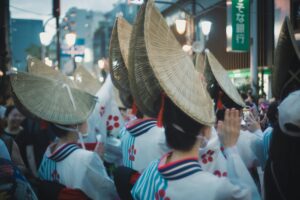
The most philosophically significant of Japan’s summer observances is Obon (お盆) — the period, usually around mid-August, when the spirits of the dead are understood to return to the world of the living. Families travel home. Graves are cleaned and decorated. Bon odori (盆踊り) — circular dances performed in the streets and parks of neighborhoods across Japan — welcome and entertain the returning spirits. The fires lit at the beginning of Obon to guide the spirits home and at its end to guide them back are among the most direct expressions of the Japanese understanding of death as not an absolute ending but a seasonal condition: the dead return in summer and depart, and the living mark both movements with fire.
Autumn: The Beautiful Catastrophe
Red and Gold as a Form of Grief
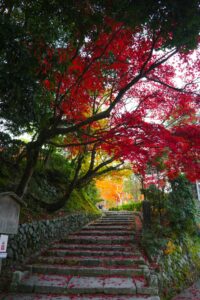
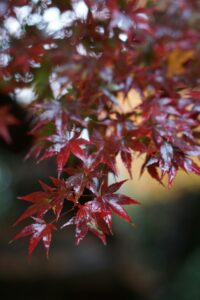
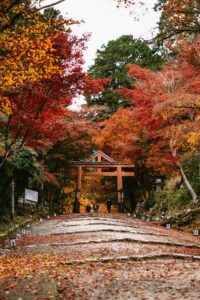
The Japanese autumn is organized around the spectacle of kōyō (紅葉) — the turning of the leaves — with the same intensity that spring is organized around cherry blossoms. The maple forests of the mountains, the ginkgo-lined avenues of the cities, the temple gardens that have been planted over centuries with the deliberate intention of producing maximum autumn color — all of these become destinations, pilgrimage sites, places where the experience of beauty mixed with the awareness of its ending is accessible to everyone who chooses to look.
Autumn also brings its specific foods — the matsutake mushrooms (松茸) that emerge after the first cold rains and are priced in Japan as luxury ingredients approaching the value of the white truffle; the chestnuts roasted on street corners; the new rice harvest of shinmai (新米), considered the finest of the year, eaten with a reverence that older, stored rice does not receive. The food of autumn in Japan is the food of abundance consciously savored — of knowing that what you are eating is at its peak, that the conditions that produced it will not recur for another year, and that eating with attention is the appropriate response to this.
Winter: The Season That Makes the Rest Possible
Stillness and the Space Before Renewal
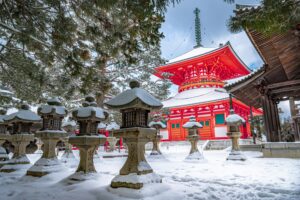
Japanese winter is the season of interiority — of the indoor warmth around which community forms, of the slow foods that require patient preparation, of the annual accounting that asks what the past year produced. The communal table heater — kotatsu (こたつ) — around which a family sits on cold evenings, legs tucked under the heat-retaining blanket, eating mikan (みかん) tangerines and watching whatever is on television, is one of the most immediately recognizable images of winter domestic life in Japan. The kotatsu is not merely a piece of furniture. It is the physical structure around which the winter version of the family constitutes itself.
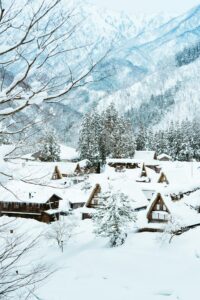
The winter solstice brings tōji (冬至) — the shortest day — traditionally marked by eating pumpkin and bathing with yuzu citrus fruit (yuzuyu, 柚子湯), both understood as practices for maintaining health through the cold months. New Year (お正月) is the most important holiday in the Japanese calendar — not because of what it celebrates but because of what it prepares for. The cleaning of the house before New Year (ōsōji, 大掃じ) is the physical and ritual clearing of the past year to make space for the new. The shrine visit on New Year’s morning is the formal beginning. Winter is the hinge on which the year turns.

The Seasons as Framework
Why Japan Kept the Seasonal Calendar
The intensity of Japan’s relationship with the seasonal cycle is not the result of a conservative culture preserving traditions that modernity would otherwise have erased. It is the result of a culture that has actively chosen, through each successive generation, to maintain this relationship as something worth the effort it requires. The winter ceremony that requires specific preparations, the spring food that is only worth eating for three weeks, the autumn garden that needs months of maintenance to be beautiful for a single week — all of these demand something of the people who practice them. The demand is precisely the point.
A culture that insists on attending to the seasonal cycle is a culture that insists on being present. It is a culture that has decided that the relationship between human life and natural time is important enough to organize institutions and calendars and habits around. This decision runs counter to the tendency of modernity, which is generally to make human life as independent of natural rhythms as possible — to make strawberries available in December and air conditioning available in August and bright light available at three in the morning. Japan has done all of these things. And it has also, simultaneously, maintained a relationship with the seasons that treats their specificity as a value rather than an inconvenience.
The Japanese year is a continuous invitation to notice — to be present to the cherry blossoms while they last, to eat the matsutake mushroom in its season, to sit under the kotatsu in winter and not wish it were otherwise. This invitation is what the four seasons of Japan ultimately extend to everyone who spends time in them: not the chance to observe nature but the chance to inhabit it, to let its rhythms organize the day, and to discover that a life calibrated to the natural year is, in ways that are difficult to explain and easy to feel, a life more fully lived.
The four seasons shape everything in Japanese culture, from the patterns on a kimono to the timing of a festival to the poem carved on a temple gate — and following them through a year in Japan is, as generations of travelers have found, the closest thing to understanding this endlessly layered country that any single journey can provide.
