The Katana: Japan’s Most Sacred Blade Explained
In a dimly lit forge in Shimane Prefecture, a swordsmith stands motionless before a blade that glows the color of a harvest moon. His hammer is raised. His apprentice waits. But the strike does not come — not yet. First, the master folds his hands, bows his head, and murmurs words that have been said in forges like this one for over a thousand years. It is a Shinto purification ritual, and it is as essential to the process as the charcoal, the water, or the steel itself. The fire is sacred. The silence is sacred. The transformation about to take place is sacred.
This is the moment that contains everything. Because the central question surrounding the katana — Japan’s iconic curved sword — is not really about metallurgy or martial history, remarkable as both are. The question is this: how did a weapon designed for battlefield killing become the spiritual and aesthetic soul of an entire civilization? How did a country look at sharpened steel and see, within it, a mirror of the human spirit?
A Weapon That Became a Philosophy
From Horse and Battlefield to Sacred Object — How the Katana’s Shape Was Born
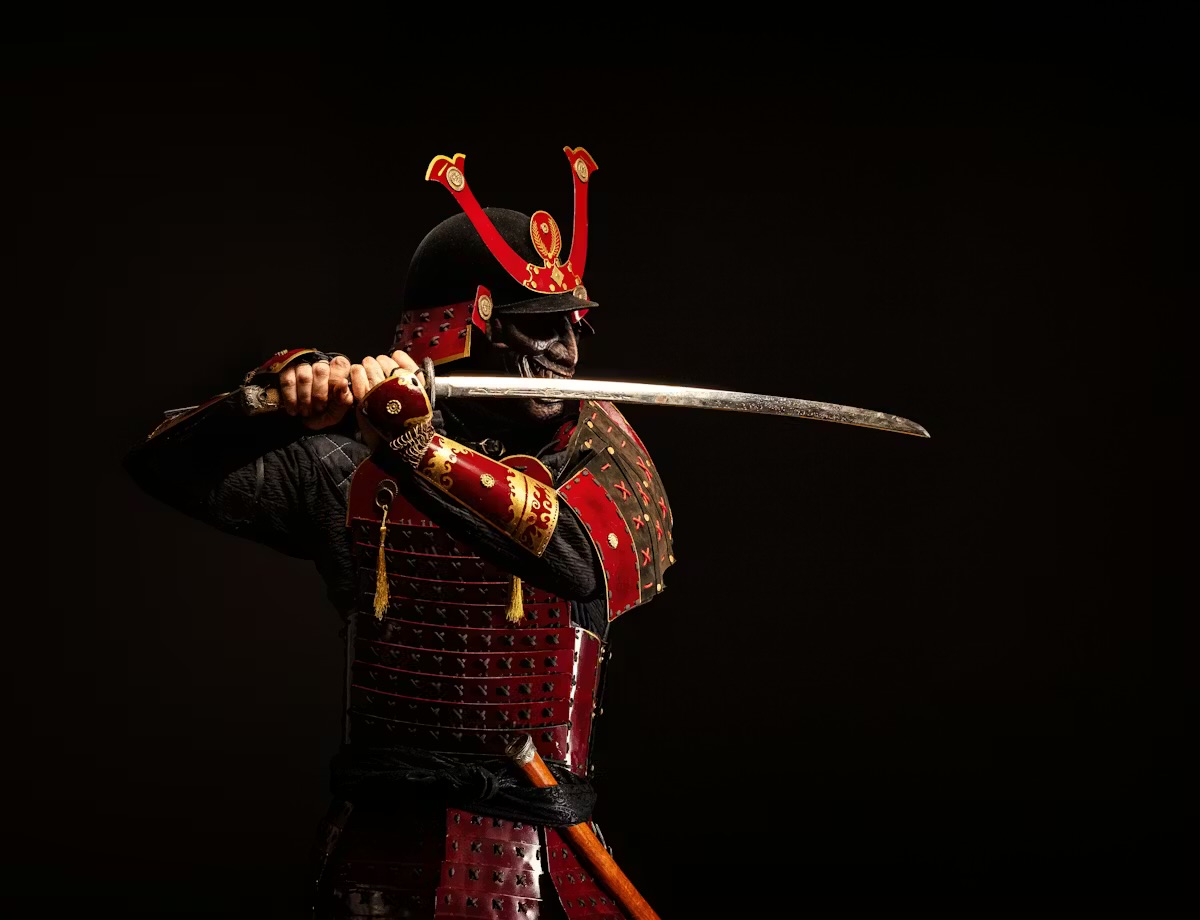
The katana’s distinctive curved form was not invented by an artist. It was demanded by a horse. Early Japanese swords of the Nara period (710–794) were straight, modeled on Chinese and Korean designs, suited to infantry combat on flat ground. But as the mounted warrior class — the predecessors of what we would come to call the samurai — rose to prominence during the Heian period (794–1185), the geometry of battle changed. A curved blade could be drawn fluidly from a scabbard worn edge-upward at the hip in a single motion that flowed directly into a cutting stroke. The curve was not decorative. It was the result of a civilization optimizing for a specific kind of lethal elegance.
Over the following centuries, through the turbulent Kamakura, Muromachi, and Sengoku periods, the sword evolved alongside the warrior class that carried it. By the time Japan unified under the Tokugawa shogunate in the early seventeenth century and the great wars finally quieted, something strange and wonderful happened. The katana — no longer needed as a daily instrument of killing — began its long transformation into a philosophical object. Samurai began to speak of the sword not as a tool of death, but as an extension of the warrior’s inner character. The blade, they said, reflected the soul of the man who carried it.
The Sword Hunt, the Edict, and Two Near-Extinctions — Why Survival Matters
The katana’s survival is, in itself, a kind of miracle. In 1588, the unifier Toyotomi Hideyoshi issued the Sword Hunt Edict (katanagari), confiscating weapons from farmers and Buddhist monks in a sweeping act of social control. Hundreds of thousands of blades were melted down. Then, more devastatingly, came Japan’s defeat in 1945 and the Allied Occupation, during which the possession of swords was banned outright and an estimated two to three million blades were surrendered and destroyed. Ancient masterworks that had survived wars and fires and centuries of use vanished in a single administrative season.
That the tradition survived at all is largely due to a coalition of scholars, collectors, and smiths who lobbied the occupation authorities to reclassify the katana as a cultural artifact rather than a weapon. They succeeded, narrowly. The swords that remain are not merely antiques. They are, quite literally, survivors — and the craftspeople who make them today carry the weight of that near-disappearance in every strike of the hammer.
Steel That Is Considered Sacred Before It Is Ever Forged
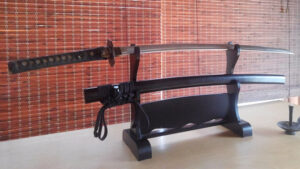
Tamahagane — The Living Material That Begins in Ritual Fire
Before a katana can be made, its steel must be born. Tamahagane — literally “jewel steel” — is a material unlike any other in the world of metallurgy. It is produced in a clay furnace called a tatara, which is itself constructed from scratch for each smelting and then dismantled afterward. Iron sand and charcoal are fed into this furnace continuously over three days and three nights, tended by teams of workers in rotating shifts. The smelter-master, called the murage, reads the color of the flame and the sound of the burning to judge the temperature — instruments he carries entirely within his own body and experience.
When the tatara is finally broken open, what emerges is a bloom of steel roughly the size and shape of a small bathtub, weighing around two tons. This is the tamahagane — a heterogeneous mass of steel with varying carbon content throughout its body. In most metallurgical traditions, inconsistency is a flaw. In the making of a katana, it is the beginning of art. The swordsmith will spend the next weeks sorting, selecting, and working this raw material into something that no industrial process has ever been able to replicate.
Folding, Layering, and the Engineering Secret Hidden Inside Every Blade
The folding process — orikaeshi tanren — is perhaps the most misunderstood step in katana-making. Popular accounts speak of a blade folded “a thousand times,” suggesting astronomical numbers of layers. The reality is both more modest and more ingenious. A typical katana involves folding the steel roughly ten to fifteen times, producing somewhere between one thousand and thirty thousand microscopic layers. The goal is not repetition for its own sake but the homogenization of carbon throughout the steel while simultaneously working out impurities and creating a grain structure of extraordinary refinement.
More remarkable still is the construction method known as kobuse or its variants, in which steels of different hardness are combined within a single blade. A hard, high-carbon steel forms the outer skin and cutting edge, while a softer, more flexible low-carbon steel forms the core. The result is a sword that can hold a razor edge — hard enough to cut — while remaining resilient enough to absorb shock without shattering. This is not primitive technology. It is a solution to an engineering problem so elegant that modern materials scientists have studied it with genuine admiration.
The Hamon — Where Science Becomes a Fingerprint of the Soul
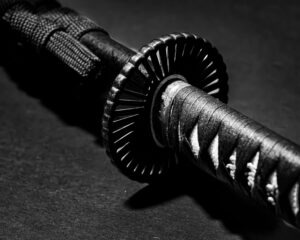
Why the Temper Line Is Not Decoration — It Is the Record of a Transformation
Along the length of every katana runs a line that separates two worlds. This is the hamon — the temper line — and it is produced during the most critical and irreversible moment of the swordsmith’s work. Before quenching, the smith coats the blade in a carefully composed clay mixture, applying it thick along the spine and thin near the edge. When the blade reaches its critical temperature and is plunged into water, the clay-insulated spine cools slowly, forming tough pearlite steel, while the exposed edge cools instantly, forming hard martensite. The hamon is the visible boundary between these two crystalline worlds.
No two hamon are identical. The precise chemistry of the clay, the temperature of the water, the angle of the quench, the particular character of that individual piece of tamahagane — all of these variables conspire to produce a line that is as unique as a fingerprint. Skilled sword appraisers can often identify a blade’s maker, period, and province from the hamon alone. It is the steel’s autobiography.
Nie, Nioi, and the Art of Reading a Blade by Candlelight
Within the hamon, the trained eye can discern two distinct types of crystalline activity. Nie refers to individual martensite crystals large enough to be seen separately, appearing like stars scattered across a night sky. Nioi refers to crystals so fine they appear as a soft, misty glow — a nebula rather than individual stars. The interplay between these two qualities, and the shapes they take along the hamon’s edge, forms an entire visual vocabulary that Japanese sword connoisseurs have spent centuries developing. The ideal way to read a blade, traditionalists insist, remains candlelight — not because it is romantic, but because the flickering, directional illumination causes the crystalline structures to reveal themselves in motion, like something alive beneath the surface of the steel.
Seven Pairs of Hands — The Hidden World of Craftspeople Behind One Sword
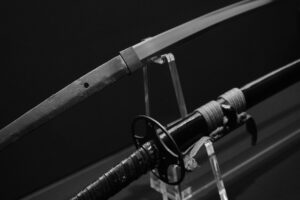
The Polisher, the Scabbard Maker, the Tsuba Artist — A Civilization of Specialists
When a swordsmith completes his work, the blade that leaves his forge is unrecognizable as the finished object we associate with the katana. It is rough, grey, and unpolished. What happens next requires the participation of an entire ecosystem of specialized craftspeople, each of whom has spent decades mastering a single discipline.
The togishi, or polisher, works the blade through a sequence of polishing stones of increasing fineness — a process that can take weeks and is in many ways as technically demanding as the forging itself. The polisher does not merely make the blade shine. He reveals it, removing material in carefully controlled microns to bring out the geometry of the blade and allow the hamon to emerge in its full complexity. Then come the makers of the sword’s fittings and mountings:
- The sayashi shapes the saya (scabbard) from carefully selected magnolia wood, fitting it so precisely that the blade enters and exits with a soft, satisfying whisper.
- The tsuba (hand guard) is crafted by a metalsmith who may spend months on a single piece, working in iron, copper, or shakudo alloy to create images of landscapes, animals, or abstract designs of astonishing delicacy.
- The handle wrapping, or tsukamaki, involves a specialist who binds silk or cotton cord in a precise diamond pattern over ray skin, creating a grip that is both beautiful and functional under a sweating hand.
A single katana, fully mounted and complete, may represent the coordinated labor of seven or more master craftspeople. It is not an object made by an individual. It is an object made by a culture.
What the Menuki Knew Before Anyone Asked — Function Disguised as Beauty
Hidden beneath the handle wrapping, pressed against the ray skin, are two small ornamental sculptures called menuki. At first glance they appear purely decorative — tiny dragons, cranes, or mythological figures rendered in gold or copper alloy. But they are positioned precisely to fill the hollows of the gripping hand, improving purchase and reducing fatigue. Beauty performing function so seamlessly that the function becomes invisible: this is perhaps the most characteristically Japanese design principle in all of material culture, and you can find it expressed in miniature within the grip of a sword.
The Sword That Gives Life — Japan’s Living Philosophy of the Blade
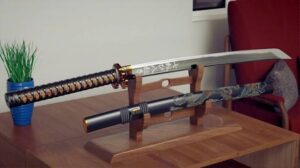
Katsujinken vs. Satsujinken — The Ethical Universe Built Around a Weapon
Perhaps no other civilization has built so elaborate a philosophical and ethical framework around a weapon. At the heart of Japanese sword philosophy lies a tension expressed in two opposing concepts. Satsujinken — “the sword that takes life” — represents the blade used in its most literal, destructive capacity. Katsujinken — “the sword that gives life” — represents something far more challenging: the idea that mastery of the sword, when cultivated with the proper spirit, can protect and preserve life, resolve conflict without bloodshed, and elevate the practitioner toward a kind of moral and spiritual clarity.
This concept is associated most powerfully with the sixteenth-century Zen monk and sword master Takuan Soho, whose letters to the swordsman Yagyu Munenori formed the philosophical bedrock of what would later be called budo — the martial way. The sword, Takuan argued, was never really about the sword. It was about the quality of attention, the freedom from ego, the ability to act without hesitation from a place of perfect stillness. The katana, in this reading, is a meditation device made of steel.
Three Hundred Smiths, a Succession Crisis, and Why the World Is Paying Attention
Today, there are approximately three hundred licensed swordsmiths active in Japan — a number that sounds small and is. Each smith is permitted by law to produce no more than two long swords per month, a regulation designed to preserve the tradition’s integrity and prevent industrial scaling. The average age of practicing smiths is rising, apprenticeships are long and economically punishing, and the knowledge held by the older generation is not easily transferred. The tradition is, by any honest assessment, under pressure.
And yet the world is paying attention in ways it never quite has before. Museums from London to New York are acquiring and exhibiting katana as major works of art rather than historical artifacts. Materials scientists are publishing papers on the properties of tamahagane. A new generation of Japanese craftspeople, inspired partly by global interest in artisan culture, is beginning to see a path — difficult, serious, and deeply meaningful — through the studio doors of working smiths. The katana may be ancient, but it is not finished.
In the dimly lit forge in Shimane Prefecture, the swordsmith’s hammer finally falls. The blade that emerges from the quench is quivering with heat, covered in clay scale, utterly unresolved — and already, unmistakably, alive. Months of collaborative work lie ahead before it will become the complete object that will someday rest in a collector’s hands or a museum’s glass case. But the essential transformation has already occurred. Steel has become something more than steel. A tool has become a philosophy. And Japan has done, once again, what perhaps only Japan has ever done: looked at a weapon and asked not “how deadly can it be?” but “how perfectly can it reflect the human spirit?”
That question — patient, rigorous, and deeply beautiful — is the katana’s final and most lasting edge.
If the katana is Japan’s philosophy made visible in steel, its tea ceremony is that same philosophy made visible in stillness — discover how both traditions share a single soul.