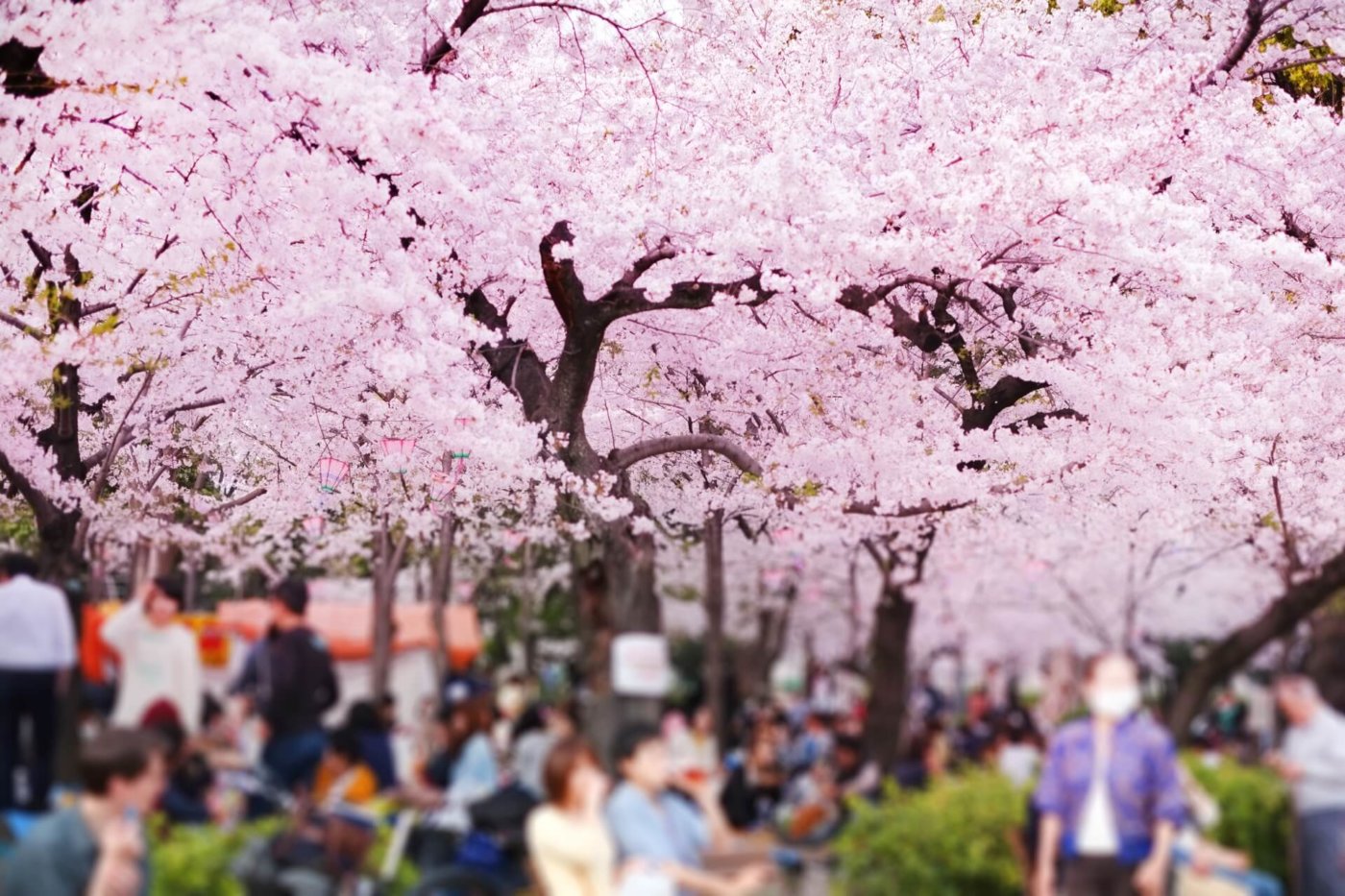
In a park in central Tokyo, a man in a business suit sits alone on a low bench. His jacket is pressed, his shoes are polished, his briefcase is set carefully at his feet. Around him, a city of fourteen million people moves at its usual unrelenting pace. But he is completely still. His eyes are not on his phone. They are not on the path ahead. They are turned upward, toward a canopy of cherry blossoms shaking loose in a slow, windblown drift of white and pale pink petals. He watches them fall the way a person might watch the sea — not looking for anything, simply looking. He is not waiting for someone. He is not wasting time. He is, in a very precise and ancient sense, doing exactly what he came here to do.
This is hanami — literally “flower viewing” — and understanding what it actually is, beneath the picnic blankets and the convenience-store sake and the Instagram photographs, is to understand something essential about the Japanese relationship with time, beauty, and the strange relief of impermanence. It is not a festival, exactly. It is not a celebration in the way the West understands celebrations. It is closer to a philosophical practice that a nation performs together every spring, synchronized not by a calendar but by the slow, branching logic of nature itself.
Before the Cherry Blossom — How Japan Learned to See Flowers
The Aristocrat’s Plum and the Poet’s Pivot
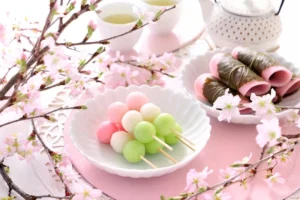
It was not always the cherry. In the earliest centuries of Japan’s literary culture, the flower that commanded reverence was the plum blossom. The great eighth-century poetry anthology known as the Man’yoshu contains poems that treat the plum with the same aching tenderness that later generations would reserve for the sakura. The plum bloomed in the cold, it carried a sharp fragrance, and it was associated with the refined culture of Tang Dynasty China — which the Japanese aristocracy admired intensely. To write about the plum was to signal sophistication, worldliness, learning.
The pivot came slowly, and it came through poetry. By the time the Kokinshu anthology was compiled in the early tenth century, cherry blossoms had begun to displace the plum in the literary imagination. The reason was not simply aesthetic. The cherry offered something the plum could not: radical, undeniable brevity. Its bloom lasted barely a week, sometimes less. It arrived in a rush and departed without apology. For a culture already developing a profound sensitivity to impermanence, that brevity was not a flaw. It was the entire point.
How a Shogun Gave Flower-Viewing to the People
For centuries, hanami remained a privilege of the aristocratic and the powerful. The emperor’s court held flower-viewing banquets beneath the trees of palace gardens, composing poems and drinking rice wine from lacquered cups. It was a cultured, contained, carefully choreographed affair. The common people watched the blossoms too, of course, but watching was not the same as the formal act of viewing — the seated, deliberate, aesthetically informed practice that the court had developed into a minor art form.
It was the warlord and unifier Toyotomi Hideyoshi who, in the late sixteenth century, began to change this. His famous flower-viewing party at Daigo (醍醐) in 1598 — attended by hundreds of guests, surrounded by transplanted trees, and celebrated with extraordinary display — signaled that hanami was becoming something larger than courtly refinement. Later, during the long peace of the Edo period, the shogun Tokugawa Yoshimune ordered cherry trees planted along riverbanks and in public spaces specifically so that ordinary citizens could participate in flower-viewing. What had been an aristocratic ritual was deliberately democratized. The picnic beneath the blossoms — the blanket on the ground, the shared food, the communal ease — became available to anyone.
The Clone, the Front, and the Seven-Tenths Bloom
Why Every Iconic Sakura Tree Is Genetically Identical
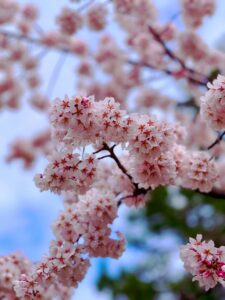
Here is a fact that startles almost everyone who hears it for the first time: the most celebrated variety of cherry blossom in Japan, the Somei Yoshino (染井吉野), cannot reproduce sexually. Every single one of the millions of Somei Yoshino trees flowering across Japan is a clone — propagated through grafting, genetically identical to a tree that was first cultivated in the Edo period. When the sakura zensen, the “cherry blossom front,” moves northward through Japan each spring — tracked on television with the seriousness of a weather event — it is tracking the synchronized awakening of what is, biologically speaking, a single individual expressed across an entire landscape.
This peculiarity gives Japanese spring its extraordinary visual coherence. The clouds of white-pink bloom that appear in photographs of Japan are so uniform, so collectively overwhelming, partly because there is no genetic variation to stagger the timing. The country does not bloom gradually in the way that a wild forest might. It blooms together, and then it stops together, and in between, it is one of the most astonishing natural spectacles on earth.
The Insider’s Secret — Why Full Bloom Is Already Too Late
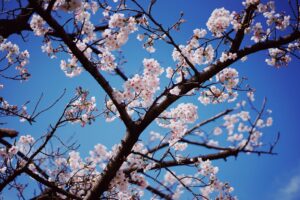
Ask a Japanese aesthete when to see the cherry blossoms at their most beautiful, and they will not say “at full bloom.” They will say nanabusaki — the seven-tenths bloom, the moment when the flowers are almost but not quite fully open. At that stage, each blossom still holds a slight tension, a sense of becoming. The full canopy has not yet closed. You can see individual flowers against the blue of the sky. The tree is, in a word, still arriving.
This preference is not contrarianism. It reflects a deep aesthetic value in Japanese culture: the idea that completion is less beautiful than the approach to completion. The seven-tenths bloom contains both presence and anticipation. It has not yet surrendered to the inevitable. And that tension — between arrival and departure, between now and already-gone — is precisely where the Japanese sense of beauty tends to live.
Mono no Aware — The Philosophy Hidden Inside a Picnic
What the Falling Petal Actually Means
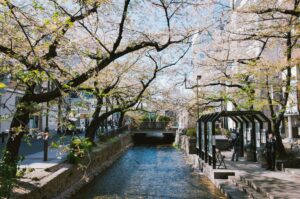
The concept that gives hanami its philosophical depth is mono no aware (物の哀れ) — a phrase that the eighteenth-century scholar Motoori Norinaga identified as the emotional core of Japanese literature and, by extension, Japanese feeling. It translates roughly as “the pathos of things,” or “an empathy toward things,” and it describes the bittersweet sensation of loving something beautiful while knowing — feeling in the chest — that it is already in the process of disappearing.
The falling cherry petal is its perfect emblem. Not the petal on the branch, not the petal on the ground, but the petal in the air — the one that has already left and has not yet arrived. That moment of suspension is where mono no aware lives. It is not sadness, exactly. It is something more complex: a heightened awareness of presence brought on by the consciousness of loss. The Japanese have known for over a thousand years what modern psychology is still working to articulate — that beauty is intensified, not diminished, by impermanence.
Dumplings Over Flowers — and Why That’s Also the Point
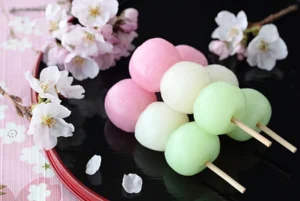
There is a Japanese proverb, affectionately ironic, that cuts through any temptation to make hanami too solemn: hana yori dango — “dumplings over flowers.” It describes the person at a hanami party who is more interested in the food and the company than in the blossoms above them. And crucially, the proverb is not entirely a criticism. Hanami was never meant to be a purely meditative experience. It is also, deeply and deliberately, a social one.
The blanket on the ground, the shared rice balls and fried chicken and canned beer, the laughter that rises above the conversation of families and colleagues and old friends — this is not a distraction from hanami. It is hanami. The flowers are the occasion; the togetherness is the practice. Japan understood something that takes other cultures longer to recognize: that presence, shared with others, beneath something beautiful and brief, is one of the most complete human experiences available to us. Dumplings and flowers are not in opposition. They are the same argument made in different registers.
What No Other Culture Has Built Around a Flower
A National Emotional Calendar Synchronized by Nature
No other culture on earth has built quite this kind of structure around a single plant. The cherry blossom forecast — the kaika yoho (開花予報) — is issued by meteorological agencies and reported on national news with a gravity usually reserved for typhoon warnings. Families consult it to plan gatherings weeks in advance. Corporations hold official hanami parties as part of the working year. Schools time events around the blossoms. The entire country, briefly, reorients itself around a flower.
This is not mere sentimentality. It represents something rarer: a society that has institutionalized the practice of paying attention to the natural world, not as recreation or tourism, but as a form of cultural maintenance. The cherry blossom season functions as a collective reset — a moment when a famously work-driven culture gives itself permission to stop, to go outside, to sit on the ground and look up at something that does not involve productivity or obligation. Japan schedules presence into the national calendar, and it does so by tying that presence to something that will not wait.
The Silence Underneath — Ma, Presence, and the Art of Doing Nothing
The man in the business suit, sitting motionless beneath the petals at the beginning of this story, is not merely taking a break. He is participating in a cultural practice that connects to one of the deepest concepts in Japanese aesthetics: ma (間) — the meaningful pause, the pregnant interval, the space between notes that gives music its shape. Ma is not emptiness. It is the fullness of a moment that has been allowed to be itself, without being filled.
Hanami, at its quietest, is the practice of ma applied to an entire season. The person who sits and simply watches the petals fall is not doing nothing. They are doing the difficult, counter-cultural thing of refusing to fill the moment with anything other than the moment itself. In a world organized around distraction and productivity, this is a surprisingly radical act. Japan has been practicing it for over a thousand years.
When the Blossoms Themselves Begin to Change
Climate, Clones, and a Beauty That May Not Survive the Century
There is an uncomfortable irony embedded in the modern cherry blossom season. The very qualities that make Somei Yoshino so visually extraordinary — its genetic uniformity, its synchronized bloom — also make it deeply vulnerable. A pathogen capable of infecting one tree is capable of infecting all of them. And the warming climate is already reshaping the season in ways that Japanese observers find troubling. Peak bloom dates have been trending earlier for decades; the kaika yoho forecasters have noted that the cherry blossom front now reaches Kyoto measurably sooner than it did a generation ago.
There is a particular ache in this fact for a culture whose central aesthetic philosophy is built on impermanence. Japan has always known that the blossoms do not last. But there is a difference between the impermanence that arrives on schedule each spring and the impermanence that may, in time, arrive too early, or not at all. The question of what happens to hanami — not just as event but as philosophy, as collective ritual, as emotional calendar — if the cherry blossom itself becomes unreliable is one that Japanese botanists, aesthetes, and ordinary citizens are beginning to ask with a new urgency.
The Return to Quiet — What Japan Is Rediscovering About Hanami
In recent years, and particularly in the quieter aftermath of the pandemic years, there has been a perceptible shift in how some Japanese people approach the season. The enormous, crowded hanami parties — the tarpaulins staked out at dawn, the amplified music, the corporate gatherings of fifty — have not disappeared, but something quieter has reasserted itself alongside them. A preference for smaller gatherings, for early-morning visits when the parks are nearly empty, for sitting alone or with one other person and simply watching.
This is not nostalgia. It is, perhaps, a return to something closer to the original practice — the aristocrat beneath the plum, the poet reaching for a word to hold what cannot be held. Japan is rediscovering that hanami does not require an audience. It requires only attention, and the willingness to feel what it means to love something that is already, even as you watch it, in the act of leaving.
When the petals are gone, the branches are left bare — or rather, what Japanese aesthetes would call honest. The tree does not pretend. It does not hold onto what has already departed. In some traditions of Japanese thought, the empty branch is the most beautiful moment of all, because it contains, without concealment, the entire truth of what it is to be alive in time. The hanami season is Japan’s oldest and most elegant answer to a question every culture struggles with: how do we stay present inside something beautiful that is already leaving? The answer, it turns out, is to sit down, look up, and not look away.
To go deeper into the Japanese aesthetics that shaped this sensibility, explore our piece on wabi-sabi — the philosophy that finds beauty precisely where the West looks away.