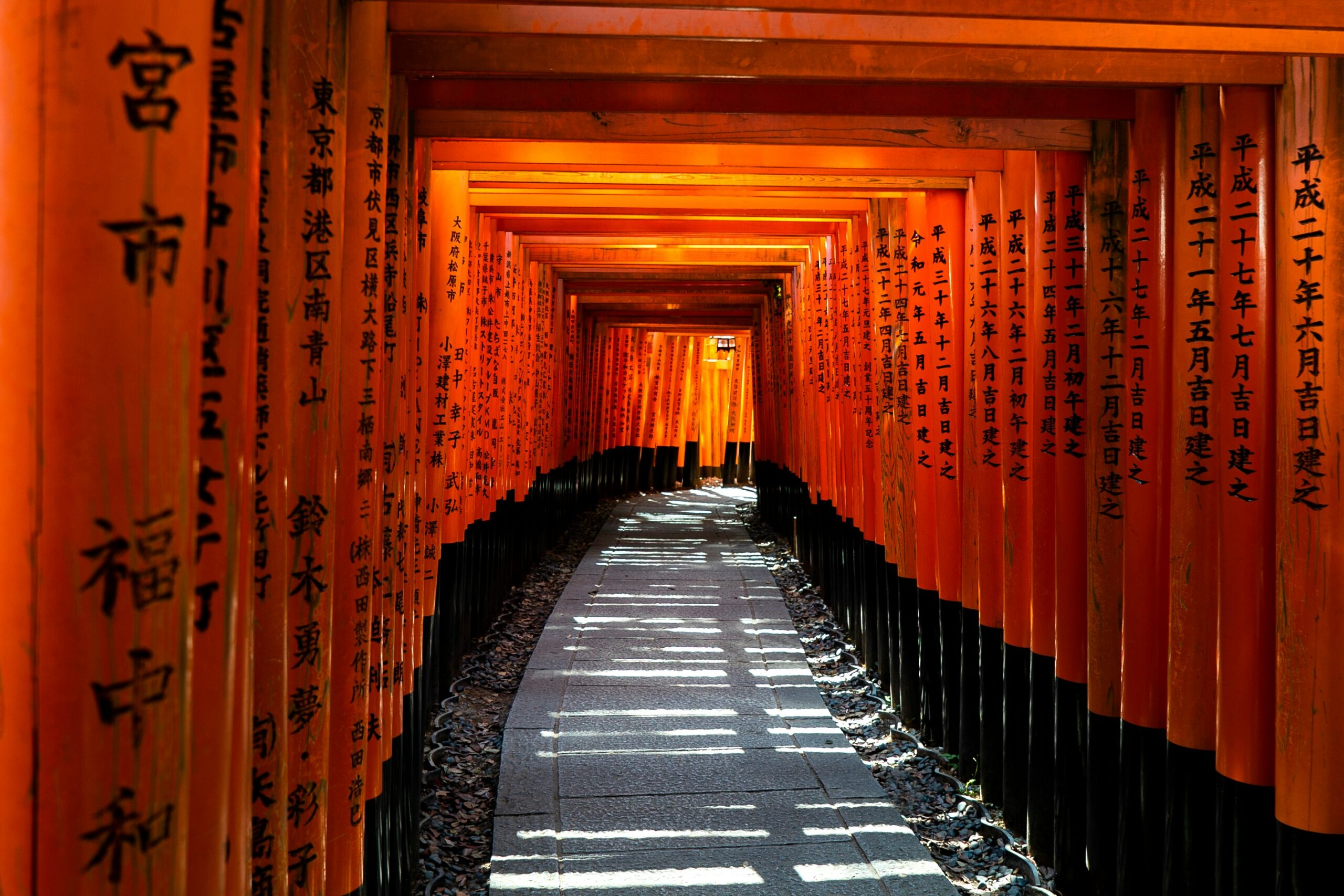
twentieth and fiftieth gate, when you stop
counting.
The vermilion columns rise on either side
and converge overhead in a rhythm the eye
follows automatically — the same interval
repeated until repetition becomes something
else. Becomes immersion. Becomes a kind of
walking meditation you did not plan to enter.
The kanji inscribed on the backs of the
pillars scroll past in the corner of your
vision: names, dates, the compressed record
of a wish made permanent. You are moving
through prayer. Not metaphorically. Each of
these ten thousand gates was placed here by
a specific person — someone who wanted to
give their gratitude a form that would
outlast them. That form is still here.
Fushimi Inari-Taisha (伏見稲荷大社) sits at the base of Mount Inari (稲荷山) in the southeastern corner of Kyoto (京都), and it is, by any measure, the most visited shrine in Japan. What the visitor numbers cannot convey is why — what it is about this particular mountain, this particular combination of color and forest and accumulated sacred attention, that draws people back across seasons and decades and, in many cases, entire lifetimes. The answer has to do with the nature of what Fushimi Inari actually is: not a monument, not a scenic destination, but a living place of worship that has been in continuous active use for over thirteen hundred years and wears that continuity in every surface and every shadow.
Inari: The God of Everything That Grows
From Rice Fields to Trading Floors
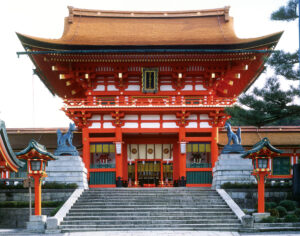
Inari (稲荷) is among the most complex and far-reaching deities in the Japanese pantheon — a kami (神) whose original domain was rice and the fertility of the harvest, and whose portfolio has expanded, over thirteen centuries of worship, to encompass foxes, sake, swords, industry, commercial success, and worldly prosperity in all its forms. The breadth is not accidental. It reflects the way that a civilization’s central anxieties shift over time: from the terror of a failed harvest to the terror of a failed enterprise, from praying for enough rice to praying for enough customers, from the farmer standing at the edge of his field in spring to the entrepreneur standing at the edge of her first business. Inari absorbs all of it. The god of rice became, by extension, the god of everything that requires cultivation and luck and the patient application of effort over time.
The fox — kitsune (狐) — is Inari’s messenger, not Inari itself, a distinction that matters even if it is frequently collapsed in popular understanding. The stone fox statues that stand in pairs at the entrance to every Inari subsidiary shrine hold in their mouths one of four objects: a key (to the rice granary), a jewel (representing fulfillment of wishes), a sheaf of rice (abundance), or a scroll (sacred knowledge). Each is an aspect of what Inari can grant; each is what the fox has been sent to deliver. The fox is the appropriate messenger for this deity because the fox, in Japanese spiritual understanding, is a liminal creature — one that inhabits the boundary between the human and the divine, between the visible and the hidden, between this world and the one just behind it. To have a fox as your messenger is to acknowledge that what you are asking for exists at a border that cannot be crossed directly.
At Fushimi Inari, the fox statues are everywhere — at the base of the gates, at the entrance to the dozens of small subsidiary shrines that line the mountain path, at the summit shrines tucked between the roots of old cedar trees. Their stone faces are worn to smoothness by centuries of weather and by the fingers of worshippers who have touched them in passing. They sit in postures of absolute patience, watching everything and reacting to nothing, their expressions impossible to read. By the time you have climbed to the upper mountain, you have developed a peripheral awareness of them that you did not have at the start — a habit of noticing the watching stone in the shadows that persists, for some visitors, for days after the visit ends.
A Gate for Every Prayer
The Material Form of Gratitude
Every torii gate at Fushimi Inari was donated. The inscription on the inner face of each pillar records the name of the donor and the date — sometimes with a brief additional phrase, in gratitude, or for the flourishing of this enterprise, or simply the name of the business that funded it. Individuals, families, small shop owners, major corporations: the tradition of donating a gate — called torii hōnō (鳥居奉納) — extends back centuries, and every gate in the network represents a specific moment when a specific person decided that their prayer or their gratitude deserved a permanent form. Ten thousand such moments, accumulated over time, placed end to end on a mountain and maintained across generations: this is what you walk through.
The size of the gates varies from structures wide enough for several people to walk abreast — the oldest, in the main Senbon Torii (千本鳥居) corridor — to narrow openings barely wide enough for one, the donations of individuals of modest means who wanted their prayer to stand alongside those of the corporations. There is a democracy to this arrangement that is easy to miss in the overwhelming visual effect of the tunnel. The smallest gate, donated by a single person for a single reason, stands in the same corridor as the large ones donated by the country’s most powerful companies. The mountain receives them all without distinction. This is also true of the prayers.
The lacquer on the oldest gates in the deep sections of the mountain has darkened over decades, cracked along the grain of the wood, faded toward the rust-orange that vermilion becomes with age. The stone bases beneath them are covered in moss and the inscriptions are worn to near-illegibility by rain and time. Walking deeper into the mountain is walking further back through the record of these gifts — from the bright new donations near the base to the old, quiet ones near the summit, each carrying in its material condition the evidence of how long it has been standing here, receiving the world.
Spring: Pink Against Red
Blossoms, Haze, and the Prayers of New Beginnings
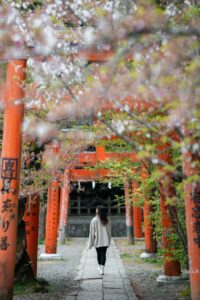
Spring at Fushimi Inari has a specific color relationship at its center: the pink of cherry blossom (sakura, 桜) against the red-orange of the torii vermilion. It is a combination that has been photographed thousands of times and still resists full capture, partly because the blossoms are never still — they move constantly in the spring wind while the gates do not — and partly because the contrast between the two colors shifts with every change in the light. In the early morning, when the sun is low and pale, the blossoms and the lacquer approach each other in tone, and the lower mountain has the quality of a color field painting, everything slightly the same. By midday, the contrast sharpens, and the pink blazes against the red. By evening, both darken, and the gates and the blossoms become, briefly, the same deep color before the light goes entirely.
The upper sections of the mountain — above the Okusha Hohaisho (奥社奉拝所) rest point at the midpoint of the climb — are quieter in spring than the lower precincts, where the cherry trees cluster most densely. Spring haze, kasumi (霞), is a meteorological fact of the Kyoto basin in April: a soft atmospheric diffusion that lifts from the lowlands in the mornings and wraps the higher sections of the mountain in a gauze of blue-white light. In this haze, the upper gates appear and disappear as the path turns through the trees, materializing and dissolving in a way that gives the mountain, in spring, a quality not unlike the classical Japanese ink painting tradition — the form implied rather than stated, the detail withheld, the imagination asked to complete what the eye cannot fully see.
April is also the month of new beginnings in the Japanese calendar: the start of the school year, the fiscal year, new employment, new chapters. The prayers offered at Fushimi Inari in spring carry this specific quality — concentrated, forward-looking, full of the particular human hope that belongs to things just started. The mountain at cherry-blossom time is busy, and the quality of the attention in the crowd is distinct from any other season: everyone here, it seems, has something specific they are asking for. The fox statues watch from the bases of the gates with their customary patience, and the blossoms fall across the stone path in the wind.
Summer: The Green Dark and the Cicadas
The Mountain Closes Over
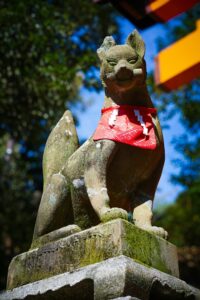
By midsummer, the mountain has become a different place. The deciduous canopy has fully closed, turning the light on the upper paths to a deep green that makes the vermilion of the gates appear to generate their own warmth — as though the color is being produced from within rather than reflected from without. The contrast between the cool green of the forest and the warm orange-red of the lacquer is at its most intense in July and August, and the effect in the older, denser sections of the path, where the trees have grown close to the gates on both sides, is close to overwhelming: a tunnel of color inside a tunnel of structure, the eye unable to settle on any single element.
The cicada (semi, 蝉) provides the soundtrack. Their sound at Fushimi Inari in midsummer is total — a continuous, high-frequency tone that fills the mountain forest from every direction simultaneously, so uniform that it stops registering as sound and becomes instead a quality of the air itself. On the lower mountain, it competes with the ambient noise of the city that lies just below; on the upper paths, above the midpoint, the city drops away and the cicadas achieve complete acoustic dominance. Japanese classical poetry has associated the cicada’s song with the awareness of impermanence for over a thousand years — with the brief, burning intensity of the present moment and the silence that follows — and at Fushimi Inari in July, with the sound everywhere and the gates enclosing you and the fox statues watching from the shade, the association feels less like a literary convention and more like an observation.
The Yoi-miya festival (宵宮祭), held at the shrine in late July, lights the mountain at night with lanterns and restores to it, for one evening, the full ceremonial life of the institution it has always been. The combination of summer heat, lantern light, the smell of festival food drifting from the lower precincts, and the knowledge that this ceremony has been held in some form for most of the shrine’s existence gives the Yoi-miya a quality of deep continuity that the festival season in many Japanese cities preserves but that at Fushimi Inari feels especially unbroken.
Autumn: Two Shades of Red
Maple and Lacquer, Competing and Combining
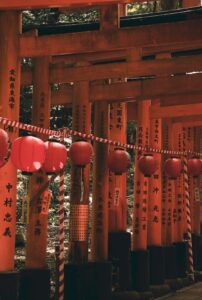
The autumn color change at Fushimi Inari happens in November, when the maple trees on the upper mountain turn from yellow through the specific orange-red — and then, at peak, to the deep pure red — that is Japan’s most celebrated autumn color. The visual encounter between this red and the torii vermilion is one of the most remarkable natural-architectural combinations anywhere in Japan: two distinct but related shades of red, the organic and the manufactured, the trembling and the still, the temporary and the enduring, placed together by the accident of where the maple trees were planted relative to where the gates were built, and producing a result that no single hand designed but that looks designed, looks as though someone knew exactly what they were doing when they put these two things next to each other.
When the autumn sun is low — in the late afternoon of October and November — it comes through the maple canopy from the side rather than from above, and the light it produces is horizontal and golden and catches both the leaves and the lacquer simultaneously. For approximately twenty minutes around dusk, the upper sections of the path are illuminated in a compound color — red on red in golden light — that is unlike anything visible at any other time of year. The fox statues, in this light, acquire a warmth that their grey stone does not usually possess. The inscriptions on the gates’ inner faces, usually in shadow, become briefly legible in the low light. Everything on the mountain, for those twenty minutes, seems to be revealing something it normally keeps concealed.
Autumn is also the season most directly connected to Inari’s original agricultural identity. The rice harvest — completed in October across most of Japan — was the annual culmination of the year’s hope, the moment when the spring prayers became measurable in the weight of the granaries. The quality of gratitude at Fushimi Inari in autumn is different from the quality of hope in spring: more settled, more specific, more weighted with the year’s full experience. The leaves fall from the maples and collect in drifts at the base of the gates, and the mountain begins its long preparation for winter.
Winter: The Mountain Stripped Bare
Snow, Cold Light, and the First Prayer of the Year
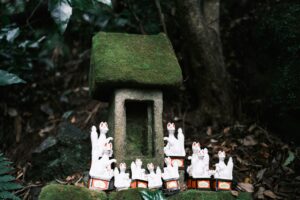
Snow is rare in Kyoto. The basin geography moderates the temperature, and years pass without significant accumulation. But when snow falls on Fushimi Inari — which happens, in a typical winter, once or twice — the result is one of the most visually arresting combinations in Japanese landscape: white against the specific, saturated vermilion that cold temperatures and winter light bring out with unusual intensity. The snow settles on the crossbeams of the gates and on the heads of the fox statues and along the edges of the stone path, and the mountain becomes, for as long as the snow lasts, a place of extraordinary visual precision — every form outlined in white, every color brought forward against its contrast.
Snow on Fushimi Inari cannot be planned. It happens when it happens, and the people who are present when it does have arrived, usually without knowing it, at something genuinely rare. The photographs that circulate of the snow-covered gates are among the most widely shared images of Japanese winter, and their quality of the-right-place-at-the-right-time is part of what makes them affecting. The mountain offers this gift without announcement and withdraws it within hours as the snow melts in the afternoon sun. The gates stand through it all with the same patience they bring to every other condition.
On New Year’s Eve and the following days, Fushimi Inari receives approximately three million visitors — making it one of the three most popular destinations in Japan for hatsumode (初詣), the first shrine visit of the new year. The lower precincts, normally quiet at midnight, fill with the entire ritual apparatus of the new year: the crowds pressing toward the main hall, the smell of incense and the steam from food stalls, the sound of the purification bell, the cold air carrying voices from every direction. To offer the first prayer of a new year at a place that has been receiving first prayers for over a thousand years is to participate in one of the most continuous human rituals in Japan. The mountain has been here for all of them. It will be here for the ones that follow.
After Dark: The Real Fushimi Inari
The Mountain That Never Closes
Fushimi Inari-Taisha has no closing time. The gates stand open at every hour, and the experience of the mountain after midnight is qualitatively different from anything the daylight hours offer — different in a way that cannot be fully prepared for and that changes the relationship to the place permanently once you have had it. The lower precincts are lit, and the illuminated gates create a theatrical version of the tunnel effect: the lacquer reflecting the artificial light from below, the columns casting hard shadows, the space between gates and forest more absolute than in daylight. It is beautiful in the way of things designed to be seen, and it is not what the nighttime mountain is about.
What the nighttime mountain is about begins where the lights end. Above the lit zone, the path enters genuine darkness — the cedar canopy overhead blocking the stars, the only illumination the small oil lanterns burning at the subsidiary shrines along the way and the distant glow of the city suspended somewhere below the treeline. In this darkness, the fox statues are different things. In daylight they are beautiful stone objects in a beautiful landscape. In the dark, lit only by their small lantern flames, their worn features become genuinely ambiguous — the expression on a stone fox face, in candlelight, at two in the morning on an empty mountain, is not the same expression it wears in the afternoon. This is what the Japanese aesthetic tradition means when it speaks of ma (間) — the meaningful interval, the productive emptiness, the space where perception expands to fill what has been withheld. The darkness at Fushimi Inari is full of things that the light, during the day, prevents you from noticing.
People who have walked the full circuit alone in the late night — four kilometers from the base to the summit and back down by the alternate path — describe the experience consistently in terms that have nothing to do with tourism. The mountain at two or three in the morning belongs to itself in a way that it cannot belong to itself during the day, and what it is when it belongs to itself is different from, and more, than what the photographs and the visitor numbers suggest. The fox statues watch. The old gates stand in the dark. Whatever has been present here for fourteen centuries continues to be present, uninterrupted, whether anyone is there to observe it or not.
The Summit: Why the Climb Is the Point
Sangaku Shinko and the Sacred Mountain
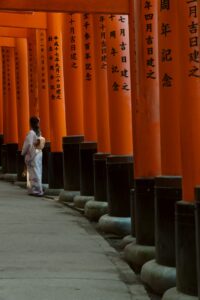
The concept of mountain worship — sangaku shinko (山岳信仰) — has been at the center of Japanese spirituality since before any written record exists to document it. Mountains are understood as the dwelling places of kami, as the points where the vertical axis connecting earth and heaven comes closest to the surface, as places where the membrane between the ordinary world and the sacred world is thinnest. The act of climbing a sacred mountain — on foot, slowly, through whatever it takes — is itself a form of prayer. The effort is not incidental to the spiritual act; it is constitutive of it. You do not go up the mountain and then pray. The going up is the prayer.
At Fushimi Inari, this principle is made architectural. The path from the main hall at the base to the Ichinomine (一ノ峰) summit shrine — approximately two kilometers of climbing — is marked every few meters by a gate, each one donated as an act of prayer, so that the path through the mountain is simultaneously a path through the history of every prayer the mountain has received. As the path climbs, the gates change: the formal, well-maintained structures of the busy lower sections give way to smaller, quieter gates whose lacquer has faded toward wood-color, whose inscriptions are worn to near-illegibility, whose stone bases are deep in moss. These older gates carry in their condition the evidence of how long they have been standing here. Some of them have been weathering on this mountain since before the oldest person now living was born.
The summit area, when you reach it, is quiet in a way that the lower mountain rarely achieves. The city that surrounds Fushimi Inari on three sides is invisible from here; the forest closes around the small cluster of shrines at the peak; the subsidiary shrines are attended by fox statues whose stone faces are worn to near-abstraction by the accumulation of seasons. You have moved, over the course of the climb, from one of the most photographed locations in Japan to a place where you may be entirely alone. The transition is not gradual. It happens in the upper sections of the path, past a certain threshold of altitude and stillness, and once it has happened, the relationship between you and the mountain is different from what it was at the start. The descent, back through the gates, is a return — but to what, and carrying what, is something the mountain leaves for each person to determine.
The gates are standing when you leave, as they were standing when you arrived, as they were standing before you were born. Fushimi Inari does not depend on visitors for its existence. It is a place that has its own life, organized around the continuous practice of worship that has been maintained here without significant interruption since 711 CE, and which will continue to be maintained long after the most recent gate has weathered to the same grey dignity as the oldest. What the mountain offers to everyone who comes — in spring or summer or autumn or winter, by day or by deep night — is the same thing: the experience of moving through something that has been sacred for a very long time, and that communicates that fact in the only way that time itself can communicate anything, which is through the accumulated material evidence of everything that has happened here and everything that has been given.
The sacred landscape of Kyoto extends far beyond Fushimi Inari — through temple gardens, ancient streets, and ceremonies that have been performed without interruption for a thousand years — and understanding any one part of it opens a door to understanding the whole.
