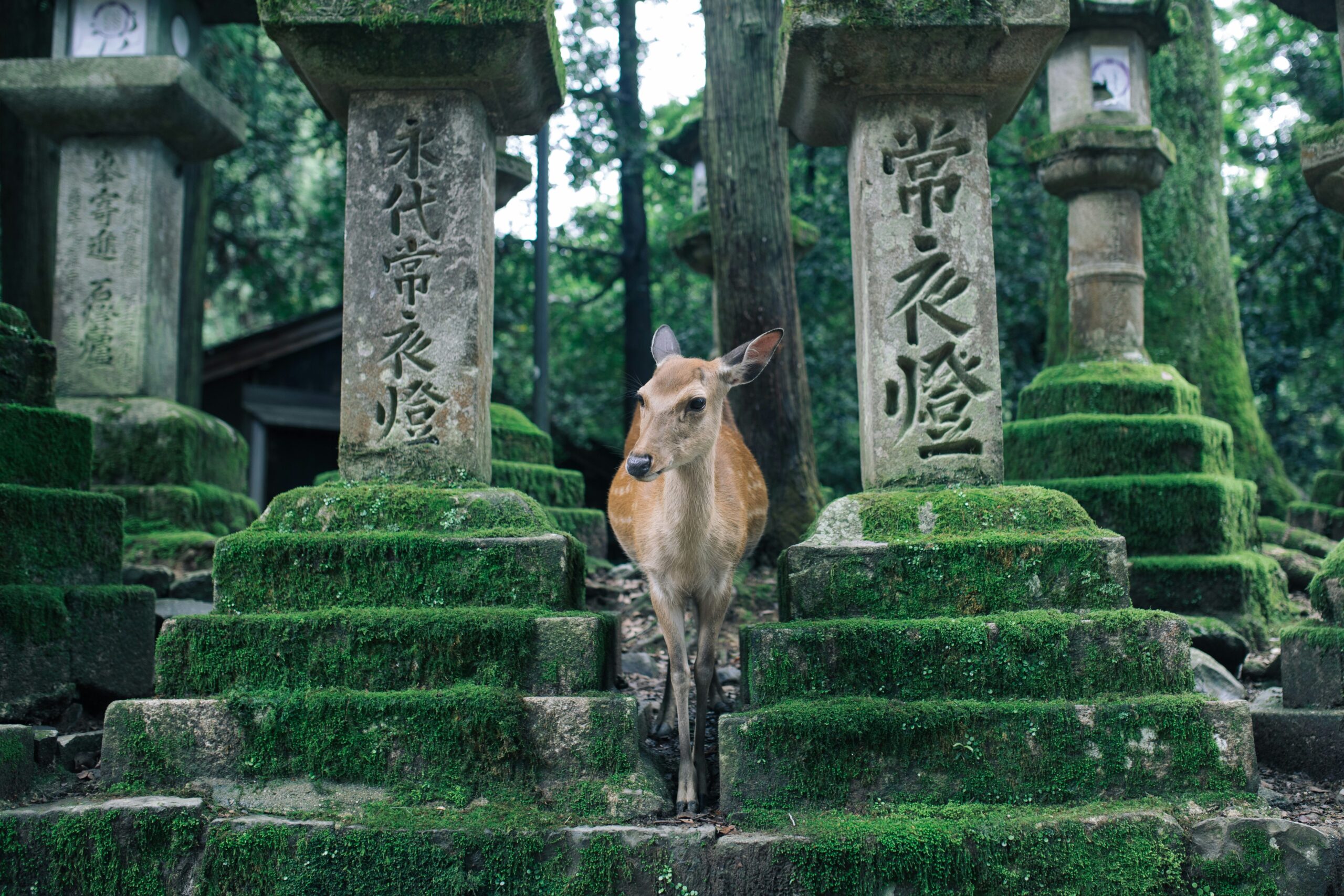
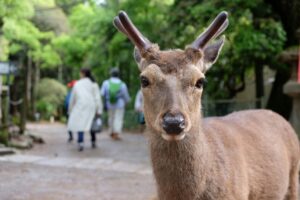
 You are standing on a stone path in Nara Park (奈良公園), reading a sign, thinking about where you are going next, when something nudges your elbow. Not a person. You turn and find a deer looking at you from a distance of approximately thirty centimeters, its large dark eyes focused with an attention that seems, implausibly, to be entirely on you. It is not afraid. It has no reason to be afraid — it has never had a reason to be afraid, and neither have any of its ancestors for the past thirteen hundred years. The nudge was deliberate. The deer has assessed the situation and decided that you are the most likely source of shika senbei (鹿せんべい) — the flat, wheat-and-bran crackers sold by vendors throughout the park — and is making its interest known with the directness of an animal that has been interacting with humans for so many generations that the category of “stranger” has ceased to exist. You are not a stranger to this deer. You are a person, and persons sometimes have crackers. The negotiation begins.
Nara (奈良) was Japan’s first permanent capital, established in 710 CE, and the temples and shrines built in that foundational period remain among the oldest and most significant in the country. The city’s deer — approximately 1,300 of them, roaming freely through the park and the surrounding temple precincts — have been considered sacred since the shrine of Kasuga Taisha (春日大社) was founded in 768 CE, and the divine messenger of the Kasuga deity was said to have arrived riding a white deer from the great shrine at Kashima (鹿島). From that moment, the deer of Nara became untouchable: protected not by a fence or a law but by the understanding that they belonged to the gods. That understanding has never entirely lapsed, and what it has produced — over more than a millennium of coexistence — is something that exists nowhere else on earth.
The Deer: Wild, Sacred, and Perfectly at Home
The Most Extraordinary Urban Wildlife on Earth
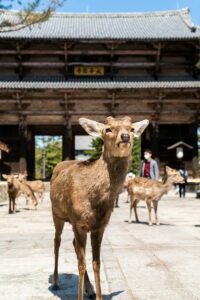
The deer of Nara are wild animals. This bears repeating because the experience of encountering them — in the middle of a city, at arm’s length, unrestrained and unmanaged — produces a cognitive dissonance that keeps asserting itself even as you are living it. There is no fence. There is no handler. The deer that walks between your legs while you try to take a photograph, the deer that sits on the steps of the shopping arcade looking out at the street with the expression of a person waiting for a bus, the deer that has wandered into the courtyard of a temple and is grazing on the moss between the stone lanterns — these are all wild animals making entirely autonomous decisions about where to be and what to do. They have simply made those decisions, consistently, for fifty generations, in the company of humans, because the humans have never given them a reason to do otherwise.
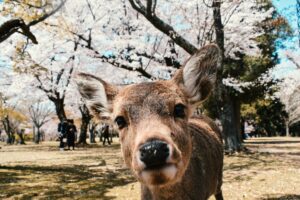
The bowing deer — a behavior that visitors photograph with delight and that has become one of the most recognizable images of Nara in the world — is understood differently depending on who you ask. Animal behaviorists suggest it is a conditioned response learned from the humans who bow before offering the crackers, reinforced over decades of the behavior being rewarded with food. Locals tend toward a more poetic interpretation: that the deer have absorbed, through long proximity to a culture organized around ritual courtesy, something of the habit of acknowledgment. Both explanations feel partly right and partly insufficient. What is certain is that the bow, when it comes — a smooth, deliberate dip of the head and neck, held for a moment before lifting — produces in the human receiving it a response that is entirely disproportionate to its cause. A deer has bowed to you. Something has happened.
The shika senbei exchange is the most direct point of contact between the human visitors and the deer population, and it has a character that is different from feeding animals in any other context. The deer know what the crackers are and where they come from and how to get them, and they pursue this knowledge with a single-mindedness that can tip rapidly into something resembling aggression — a gentle, persistent, entirely non-threatening form of insistence that communicates, with great clarity, that the deer has assessed the situation and decided that you are going to give it a cracker. The transaction that results — money to vendor, crackers to visitor, crackers to deer, deer moving on to the next available human — is one of the most repeated interactions in Nara Park, happening several thousand times a day, and it never becomes entirely ordinary. Every exchange is between a specific person and a specific wild animal, and both parties are paying attention.
The Deer Through the Seasons
Spring Fawns and Autumn Antlers
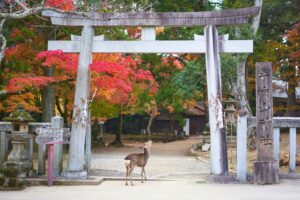
Spring brings the fawns. Between May and July, the female deer give birth in the forested edges of the park, and the fawns — spotted white on brown, impossibly small, moving with the wobbling uncertainty of things that have not yet settled into their bodies — appear gradually in the open areas over the weeks that follow. The fawn is arguably the most affecting animal in the world at close range, and in Nara Park, where the distance between the human visitor and the newborn wild animal is routinely measured in centimeters, the effect is reliable and complete. The mother deer in spring are watchful in a way their usual equanimity does not suggest — the only season when the deer’s trust in humans shows its limit, when a particular quality of stillness around the females communicates that the proximity they normally accept has a boundary that the fawns have moved closer. Even in this, the relationship is negotiated rather than enforced: the deer defines the distance; the humans, for the most part, respect it.
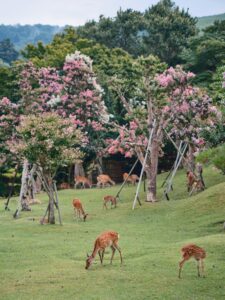
Autumn brings the antler-cutting ceremony — the Shika no Tsunokiri (鹿の角切り) — held each October in the deer enclosure near Kasuga Taisha. The male deer, whose antlers grow through the summer and are fully formed by October, have them removed in an ancient ritual that dates to the Edo period (江戸時代) and is conducted by Shinto priests and traditional deer handlers called seko (勢子). The ceremony is partly practical — antlers on a deer in rut can cause significant injury to both humans and other deer — and partly ritual: an annual acknowledgment of the relationship between the human community and the deer community, a renegotiation of the terms of the coexistence. The male deer in autumn, before the ceremony, carry an authority that the rest of the year’s encounters do not prepare you for: large, alert, their full antlers giving them a scale that the gentle familiarity of the park’s daily life tends to obscure. For a few weeks in autumn, the deer of Nara remind you that they are wild.
Todai-ji: The Building That Contains the Universe
Scale as a Spiritual Argument
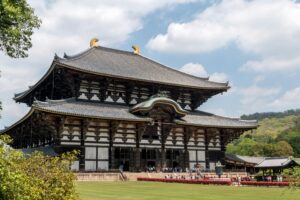
Todai-ji (東大寺) — the Great Eastern Temple — was built in the eighth century as the head temple of Japan’s provincial Buddhist network, the physical expression of Emperor Shomu’s (聖武天皇) ambition to place the entire country under the protection of the Buddha. The main hall, the Daibutsuden (大仏殿), is the largest wooden building in the world. It does not present this fact modestly. Walking toward it through the approach path — the Nandai-mon (南大門), the great south gate with its two fierce guardian statues, behind you; the deer moving around you; the building growing larger than seems possible as you approach — produces a sustained physical experience of scale that most architecture does not attempt.
Inside the Daibutsuden sits the Great Buddha (Daibutsu, 大仏) — Vairocana (毘盧舎那仏), the cosmic Buddha whose body is understood to be coextensive with the universe itself. The statue is approximately fifteen meters tall and was cast in bronze in the eighth century. The scale is conceptual as much as physical: Vairocana is not the Buddha at human scale but the Buddha at cosmic scale, and the building around the statue was constructed to house something that is, by definition, larger than anything that can be built. You stand before it and understand, viscerally, what the scale is trying to communicate: that the world you ordinarily occupy is a small place, and that the thing you are standing before is the universe reminding you of this. The deer occasionally wander in through the open doors and graze around the base of the columns, entirely unbothered.
Kasuga Taisha: A Forest Full of Lanterns
Three Thousand Lights in the Sacred Grove
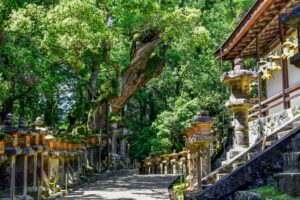
The approach to Kasuga Taisha (春日大社) runs through the Kasugayama Primeval Forest (春日山原始林) — approximately two hundred and fifty hectares of woodland that has not been logged since the shrine’s founding in the eighth century and is now a UNESCO World Heritage property in its own right. The forest that has been left alone for thirteen hundred years looks different from the forests that have been managed, cultivated, or allowed to regrow after clearing: the trees are larger, the canopy higher, the understory more complex, the silence more complete. Deer move through it in the mornings and evenings in a way that has the quality of rightness — animals in an environment that has been theirs, unchanged, for as long as their species has been associated with this place.
The stone lanterns that line the approach to Kasuga Taisha — approximately two thousand of them, donated by worshippers across the centuries — create a corridor of grey stone that changes character with the light: in direct sun they recede into the forest background; in overcast light they advance and the path narrows; in rain they gleam. Inside the shrine precincts, bronze hanging lanterns — another thousand — swing from the corridors of the inner buildings. Twice a year, during the Mantoro (万燈籠) lantern festivals in early February and mid-August, all three thousand are lit simultaneously. The effect — the shrine illuminated by its own accumulated gift of light, the cedar forest dark behind it, every lantern burning at once for the first time in six months — is one of the most transporting visual experiences in Japan, and those who attend describe it with a consistency that suggests the description is not exaggeration.
Kofuku-ji and the Park: Reflections and Five Stories
The Pagoda That Has Always Been Here
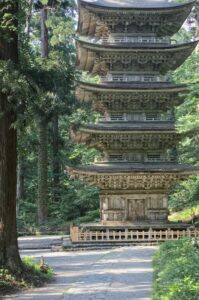
The Five-Story Pagoda (五重塔) of Kofuku-ji (興福寺), at over fifty meters the second-tallest pagoda in Japan, has been a feature of the Nara skyline since the eighth century — rebuilt five times after fires and earthquakes, always in the same location, always in the same form. Its reflection in the Sarusawa Pond (猿沢池) below the temple complex is one of the most reproduced images in Nara: the five-story silhouette doubled in still water, the sky above and its reflection below, the deer occasionally appearing at the water’s edge to drink. The composition is not composed by any human hand. It is the result of where the pond is relative to where the pagoda is, and the way the light falls in the late afternoon on certain days of the year. Nara offers this without announcement, available to anyone who stops and looks.
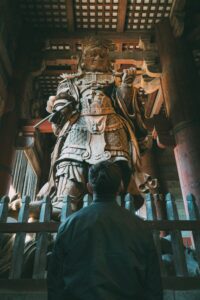
The Kofuku-ji National Treasure Hall (国宝館) contains some of the finest Buddhist sculpture in Japan, including the Ashura (阿修羅) — a three-faced, six-armed guardian deity carved in the eighth century whose expression combines, in three different faces, three states simultaneously: serenity, anger, and a third state that defies easy naming. The statue is among the most discussed works of art in Japan, and standing before it, you understand why: it achieves, in carved wood, the representation of a kind of consciousness that is genuinely difficult to describe — not because the representation is unclear but because the consciousness depicted is complex in a way that most artistic representation does not attempt.
Yoshiki-en: Quiet Beauty at the Edge of the Sacred
Three Ponds, Moss, and the Sound of Water
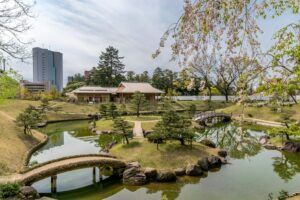
Yoshiki-en (吉城園), a short walk from the main tourist flow of Nara Park, is a moss garden of extraordinary quietness — three small ponds connected by stone paths through stands of bamboo, iris, and carefully maintained maple that create different compositions of water and plant and light at every turn. The garden is almost always less crowded than the temples nearby, and the quality of the attention it encourages — the pace that the narrow paths and the still water impose — is different from the attention that the grand scale of Todai-ji or the corridor of lanterns at Kasuga Taisha produces. Yoshiki-en works in detail: the specific way the moss covers the stones at the water’s edge, the precise reflection of a bamboo trunk in the surface of a pond, the sound of the water moving between the pools underground and emerging at the next basin.
In spring, the irises bloom along the water’s edge in a range of purples that the Japanese iris tradition has been refining for centuries. In autumn, the maple canopy turns the garden amber, and the light filtering through the leaves onto the moss below produces a color combination — green and gold simultaneously — that is one of the specific signatures of autumn in a Japanese garden. Deer occasionally enter the garden’s outer edges from the park beyond, apparently drawn by the quality of the grass along the water margins. They move through the composed landscape with the ease of animals who know that this place belongs to them as much as to anyone else — which, in Nara, is simply accurate.
Wakakusa-yama: The Hill Above Everything
Grass, Sky, and the Whole City Below
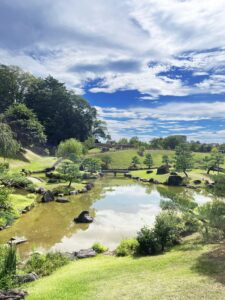
Wakakusa-yama (若草山) — a rounded hill of open grassland rising behind the main temple complex to a height of about 342 meters — offers a view of Nara that no other vantage point provides: the rooflines of Todai-ji and Kofuku-ji below, the city spreading into the Yamato Basin beyond, the mountains of the Yoshino range visible on clear days in the distance. The hill is covered in short grass maintained by the deer population, which graze it continuously and keep it at a consistent height that makes the entire surface accessible in a way that a taller-grass hillside would not be. The deer and the hill have made each other: the deer keep the grass short, the short grass sustains the deer, and the open hillside that results has been one of Nara’s defining landscapes for as long as anyone can document.
In January, the Yamayaki (山焼き) ceremony — the annual burning of the hill’s dry winter grass — produces one of Nara’s most dramatic nighttime spectacles: the entire hillside lit from below, the fire moving up through the dry grass in a line that climbs steadily toward the summit, the sky above the hill orange and the city below dark, fireworks launched from the base of the hill at the moment the fire begins. The ceremony has been performed since the Edo period, originally as a practical measure to renew the grassland and control pests. It is now one of the great annual celebrations of Nara — the hill giving back, once a year, all the light that it has absorbed through the year, and the city watching from below.
The Nara Table: Ancient Flavors, Living Craft
Fermented, Preserved, and Perfectly Specific
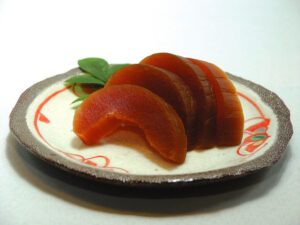
Nara-zuke (奈良漬け) — vegetables preserved in sake lees, the byproduct of the sake brewing process — is one of Japan’s oldest and most distinctive preserved foods, produced in Nara since at least the Nara period (710–794 CE) and still made by the same families in the same city in much the same way. The vegetables — typically white gourd, cucumber, watermelon rind, ginger — are packed in sake lees and left to ferment, absorbing the complex, yeasty sweetness of the lees over months or years. The result is a pickle unlike any other: deep amber in color, rich with a flavor that is simultaneously sweet and savory and slightly alcoholic, with a texture that has softened to something between crisp and yielding. Nara-zuke tastes like time. It tastes like the specific combination of place and process that produced it — which is the definition of a food that has not been standardized out of its particularity.
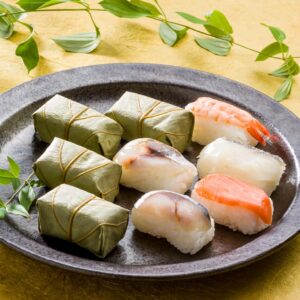
Persimmon leaf sushi (kakinoha-zushi, 柿の葉ずし) is the most visually distinctive of Nara’s regional foods: small portions of pressed mackerel or salmon sushi wrapped individually in preserved persimmon leaves, the leaf’s tannins acting as a natural preservative and imparting a subtle, astringent fragrance to the rice and fish within. The tradition developed in the days before refrigeration as a way to make fresh fish available inland — Nara, with no coastline, was dependent on preserved fish from the sea — and the specific combination of the persimmon leaf and the vinegar-seasoned rice and the salted fish has been refined over centuries into a form that is as elegant as it is practical. Unwrapping each individual leaf reveals a small, perfect package; the act of unwrapping is part of the experience. Miwa somen (三輪そうめん) — the fine, white wheat noodles produced in the Miwa area of Nara Prefecture (奈良県) since the seventh century — completes the picture of a cuisine organized around things that take a long time to make well and that taste unmistakably of where they come from.
The craft traditions of Nara extend beyond food: the city is one of the centers of Japanese ink production, the fine black ink used in calligraphy and brush painting, and the workshops that produce Nara ink (Nara-zumi, 奈良墨) and Nara brushes (Nara-fude, 奈良筆) are the direct descendants of the ateliers that supplied the scriptoria of the great Nara temples. To hold a piece of Nara ink or a Nara brush is to hold something made by hands that are the inheritors — at a very great distance, but an unbroken one — of the same craft that produced the documents of the Nara imperial court. The city that has kept its deer has also kept its artisans, and for the same reason: because some things are worth the effort of keeping.
The deer are still there when the last light leaves the park and the stone lanterns at Kasuga Taisha begin to glow. They graze on the grass between the temple buildings and move through the spaces between the stone lanterns with the unhurried confidence of animals that know this place is theirs. They were here before you arrived and they will be here when you leave, as they have been here for every visitor across thirteen centuries — the most patient and the most present welcome that any city in the world extends to the people who come to it.
The covenant between Nara and its deer is one expression of Japan’s deep, particular relationship with the natural world — a relationship that shapes the country’s art, its food, its spirituality, and the way it moves through the four seasons, all of which are explored in depth throughout this site.